


Trip Info
-
3-star hotel -Tea House - Lodge
-
Avaiable
-
English, Nepali
-
Kathmandu
-
Private Vehicle - Airplane
-
Kathmandu-Breakfast, Mountain-Breakfast - Lunch - Dinner
-
4200
A short overview on our Ghorepani Poon Hill with Mardi Himal Trek
This Ghorepani Poon Hill with Mardi Himal Trek brings together two of the Annapurna region’s most distinctive trekking routes in one 12-day journey.
It begins on the classic trail to Ghorepani and Poon Hill, passing through Ulleri, rhododendron forests, terraced hillsides, and traditional Gurung and Magar villages.
At 3,210 metres, Poon Hill offers an early-morning view across the Annapurna and Dhaulagiri ranges as the first light reaches the peaks.
The trail then continues through Tadapani, Ghandruk, and Landruk before entering the quieter side of Mardi Himal. Forest paths lead upward through rhododendron and oak before opening onto the high ridge above the tree line.
From Mardi Himal High Camp, Machhapuchhre rises prominently ahead, with Annapurna South and Hiunchuli adding to the mountain panorama.
The trek reaches the Mardi Himal Upper Viewpoint at around 4,200 metres before descending through Badal Danda to Siding.
For travelers who want more than a single viewpoint, this route offers a good mix of Himalayan scenery, Gurung culture, village life, forest trails, Poon Hill sunrise, and high-altitude trekking—all within one Annapurna itinerary.
Our Route
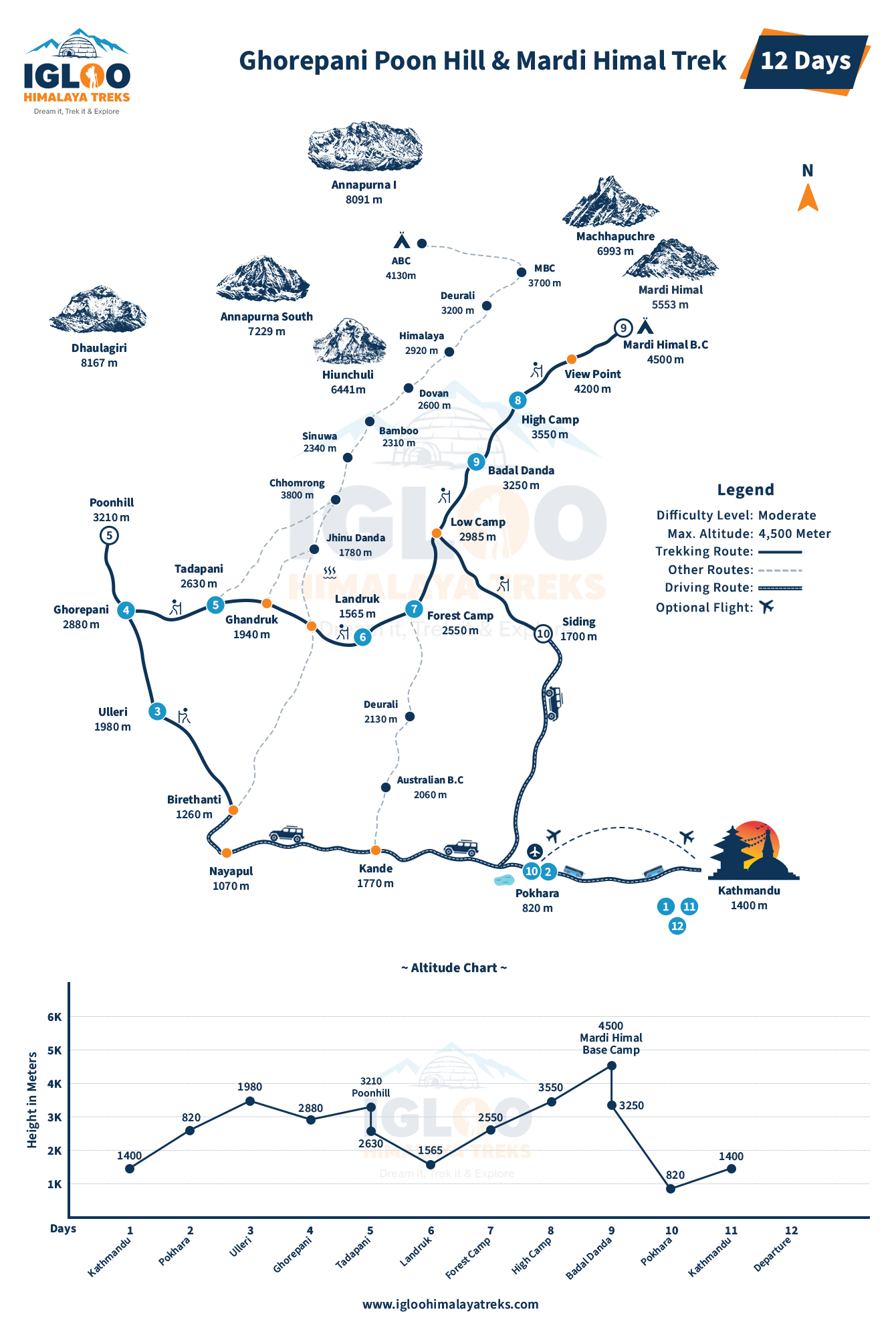
Kathmandu → Pokhara → Birethanti → Ulleri → Ghorepani → Poon Hill → Tadapani → Ghandruk → Landruk → Forest Camp → High Camp → Mardi Himal Upper Viewpoint → Badal Danda → Siding → Pokhara → Kathmandu
Highlights on our Ghorepani Poon Hill with Mardi Himal Trek
- Catch the first light at Poon Hill (3,210 m) as the sun rises over Dhaulagiri, Annapurna South, Hiunchuli, and Machhapuchhre.
- Walk through the rhododendron forests of Ghorepani and Tadapani, with the landscape changing noticeably with altitude and season.
- Experience Ghandruk and Landruk, two hillside villages where traditional houses, terraces, and Gurung culture remain part of everyday life.
- Leave the classic Poon Hill trail at Landruk and enter the quieter forest route toward Mardi Himal.
- Climb from Forest Camp to High Camp (3,540 m) as dense woodland gradually gives way to open mountain terrain.
- Reach the Mardi Himal Upper Viewpoint (4,200 m) for a closer perspective of Machhapuchhre and the Annapurna range.
- See Machhapuchhre (Fishtail) from the Mardi ridge, where the mountain becomes increasingly prominent as you gain elevation.
- Experience two distinct trekking environments in one journey—forest and village trails around Poon Hill, followed by open alpine terrain on Mardi Himal.
- Descend through Badal Danda to Siding, completing the mountain section before returning to the comfort of Pokhara.
- Combine two of the Annapurna region’s popular short treks in one itinerary, making it ideal for travelers who want varied scenery without committing to a longer circuit.
Ghorepani Poon Hill with Mardi Himal Trek Itinerary
Explore our 12-day Ghorepani Poon Hill and Mardi Himal Trek itinerary, combining Poon Hill sunrise, traditional Himalayan villages, rhododendron forests, and the high ridges of Mardi Himal.
| Day | Route | Altitude | Walking / Driving |
| 1 | Arrival in Kathmandu | 1,400 m | Airport transfer |
| 2 | Kathmandu → Pokhara | 820 m | 6–7 hr drive |
| 3 | Pokhara → Birethanti → Ulleri | 1,980 m | 4–5 hr trek + drive |
| 4 | Ulleri → Ghorepani | 2,874 m | 5–6 hr |
| 5 | Poon Hill → Tadapani | 3,210 m / 2,630 m | 6–7 hr |
| 6 | Tadapani → Ghandruk → Landruk | 1,560 m | 5–6 hr |
| 7 | Landruk → Forest Camp | 2,550 m | 5–6 hr |
| 8 | Forest Camp → High Camp | 3,540 m | 5–6 hr |
| 9 | High Camp → Upper Viewpoint → Badal Danda | 4,200 m / 3,300 m | 6–7 hr |
| 10 | Badal Danda → Siding → Pokhara | 1,700 m | 2–3 hr + drive |
| 11 | Pokhara → Kathmandu | 1,400 m | 6–7 hr drive |
| 12 | Final Departure | — | Airport transfer |
Altitude: 1,400 m
Accommodation: 3-star hotel
Meals: Breakfast
Activity: Airport transfer and trek preparation
Welcome to Nepal.
After landing at Tribhuvan International Airport, our representative will meet you and transfer you to your hotel in Kathmandu. Once you have settled in, you can rest or take some time to explore the nearby streets of Thamel.
This is also a good time to check your trekking equipment and make sure everything is ready for the journey ahead.
Your guide will brief you about the route, walking conditions, weather, and the days ahead.
Altitude: 820 m
Accommodation: 3-star hotel
Meals: Breakfast
Activity: Drive to Pokhara
After breakfast, we will begin the journey from Kathmandu to Pokhara.
The road follows Nepal’s middle hills, passing terraced farmland, small settlements, rivers, and forested slopes along the way. The journey takes around 6–7 hours, depending on road and traffic conditions.
Once we reach Pokhara, the main gateway to the Annapurna region, we will check into our hotel and settle in.
You can then spend the evening exploring the Lakeside area, walking around Phewa Lake, enjoying the views, or simply relaxing at the hotel before the trek begins the following day.
Altitude: 1,980 m
Accommodation: Teahouse
Meals: Breakfast, Lunch, Dinner
Walking: 4–5 hours
After breakfast, we drive from Pokhara toward Birethanti, where the trekking section begins.
The trail passes through small settlements, terraced fields, and forested hills before reaching Tikhedhunga. From here, the climb becomes a bit steeper as you approach Ulleri.
The long stone staircase to Ulleri is one of the first real tests of the poon hill trek. You can take your time, keep a steady pace, and use the natural breaks along the trail.
By the time you reach Ulleri, you will already feel the difference between the city and the mountains. The village sits among green hills with views toward Annapurna South and Hiunchuli.
We will spend the evening at the teahouse and rest for the next day's climb toward Ghorepani.
Altitude: 2,874 m
Accommodation: Teahouse
Meals: Breakfast, Lunch, Dinner
Walking: 5–6 hours
Today, the trail climbs gradually toward Ghorepani. Much of the route passes through rhododendron and oak forests, with the forest providing shade along the way. During spring, the rhododendrons add bright colours to the hillsides.
The trail continues through small settlements and forest sections before reaching Ghorepani, one of the most popular stops on the Poon Hill route.
After checking into our lodge, you can take some time to rest and enjoy the evening.
At night in Ghorepani, there is often music and dancing at the lodge, making it a fun way to spend the evening with fellow trekkers. You can join the dance, enjoy the music, or simply relax and get ready for an early start tomorrow.
Tomorrow begins early for the Poon Hill sunrise.
Poon Hill: 3,210 m
Tadapani: 2,630 m
Accommodation: Teahouse
Meals: Breakfast, Lunch, Dinner
Walking: 6–7 hours
Wake up early, around 4:30–4:45 AM, and begin the climb from Ghorepani to Poon Hill. The walk takes around 45 minutes to 1 hour, depending on your pace. The trail is mostly uphill, with stone steps leading through the darkness toward the viewpoint.
As you reach Poon Hill at 3,210 metres, the sky slowly begins to brighten. From the viewpoint, you can see Dhaulagiri to the west, while the Annapurna range, Annapurna South, Hiunchuli, and Machhapuchhre (Fishtail) stretch across the northern and eastern horizon. On a clear morning, the changing colours of the mountains as the sun rises make the early climb well worth it.
After spending some time at the viewpoint and enjoying the sunrise, we return to Ghorepani for breakfast. We then continue toward Tadapani, following a forested trail through rhododendron and oak trees. The route has a mix of gentle climbs and descents, with occasional openings in the forest where you can catch views of the surrounding mountains.
After several hours of walking, we reach Tadapani, a small forest settlement surrounded by hills and mountain views. It is a peaceful place to spend the evening and rest after a long day on the trail.
Altitude: 1,560 m
Accommodation: Teahouse
Meals: Breakfast, Lunch, Dinner
Walking: 5–6 hours
On day 6, we leave Tadapani and descend through forest toward Ghandruk.
Ghandruk is one of the most well-known Gurung villages in the Annapurna region. Stone houses, terraced fields, mountain views, and traditional village paths give the settlement its distinct character.
We will take time to walk through the village and experience the local surroundings before continuing toward Landruk.
The trail descends through terraces and hillside settlements before crossing the Modi Khola valley area. Landruk sits on a green hillside with views across the surrounding landscape.
Today is also the point where the character of the trek begins to change.
From Landruk onward, the route moves away from the classic Poon Hill trail and toward the quieter Mardi Himal ridge.
Altitude: 2,550 m
Accommodation: Teahouse
Meals: Breakfast, Lunch, Dinner
Walking: 5–6 hours
From Landruk, the trail leads into a quieter section of the Annapurna region.
The route climbs through rhododendron and oak forests, with fewer settlements along the way.
Moss-covered trees, forest paths, small streams, and changing mountain views make this section feel very different from the villages around Ghorepani and Ghandruk.
As you gain altitude, the forest becomes denser, and the trail becomes more secluded.
After several hours of steady walking, you finally reach Forest Camp, where we will be spending the night surrounded by the mountain forest.
Altitude: 3,540 m
Accommodation: Teahouse
Meals: Breakfast, Lunch, Dinner
Walking: 5–6 hours
Today, the trail continues upward toward Mardi Himal High Camp.
The forest gradually becomes thinner as you gain altitude. Views of Machhapuchhre, Annapurna South, and Hiunchuli become more prominent as the trail approaches the open ridge.
After leaving the tree line, the landscape changes quickly. Forest gives way to open slopes, alpine grassland, and a narrow mountain ridge.
Eventually, you reach High Camp at around 3,540 metres.
This is one of the most scenic overnight stops of the trek. With fewer trees around you, the mountains feel much closer, especially in clear weather.
Keep your warm layers nearby. Temperatures can drop quickly after sunset at this altitude.
Highest Point: Approximately 4,200 m
Accommodation: Teahouse
Meals: Breakfast, Lunch, Dinner
Walking: 6–7 hours
This is the highest and most alpine section of the trek.
We will start early from High Camp and follow the ridge toward the Mardi Himal Upper Viewpoint. The trail becomes more exposed as we move higher, with wide views across the surrounding mountains.
At around 4,200 metres, the Upper Viewpoint provides a close perspective of Machhapuchhre (Fishtail) along with Annapurna South, Hiunchuli, and other peaks of the Annapurna range.
After spending time on the ridge, we begin the descent toward Badal Danda at around 3,300 metres.
The change in altitude is much more noticeable as the trail drops back toward the forest. After the morning's high-altitude walk, Badal Danda provides a quieter and more comfortable place to spend the night.
Altitude: Siding – 1,700 m
Accommodation: 3-star hotel in Pokhara
Meals: Breakfast
Walking: 2–3 hours
The final trekking morning begins with a descent from Badal Danda toward Siding Village.
The trail gradually returns to forest and lower mountain terrain. As you lose altitude, the landscape becomes greener and warmer.
Siding marks the end of the trekking section. From here, a vehicle will take you back to Pokhara.
Once you reach Pokhara, check into your hotel and enjoy a comfortable evening after several days in the mountains.
You can relax around Phewa Lake, explore Lakeside, or simply enjoy a proper rest before returning to Kathmandu.
Altitude: Kathmandu – approximately 1,400 m
Accommodation: 3-star hotel
Meals: Breakfast
Activity: Drive to Kathmandu
After breakfast, we begin the journey back to Kathmandu.
The route follows Nepal's middle hills, passing rivers, terraced farmland, villages, and winding mountain roads.
After arriving in Kathmandu, check into your hotel and spend the remaining time as you prefer. You can explore Thamel, shop for souvenirs, or simply rest after the trek.
Meals: Breakfast
Activity: Airport transfer
Today marks the end of your Ghorepani Poon Hill with Mardi Himal Trek. After breakfast, you can spend some time relaxing or taking in your final moments in Kathmandu before your departure.
According to your flight schedule, our representative from Igloo Himalaya Treks will transfer you to Tribhuvan International Airport for your journey home.
Before you leave, we will also present you with a trekking certificate as a small reminder of the journey you completed in the Annapurna Himalayas.
As you leave Nepal, you will take home more than just photographs—a collection of memories from Poon Hill sunrise, Himalayan villages, forest trails, and the high ridges of Mardi Himal. We hope the mountains, people, and experiences you shared along the way stay with you long after you return home.
Includes
- All ground (airport/hotel) transfers by private vehicles
- Annapurna Conservation Area Permit (ACAP)
- Transportation from Kathmandu -Pokhara - Kathmandu by tourist Bus
- Transportation from Pokhara to Birethanti
- Return transportation from the trek's endpoint back to Pokhara.
- Tea house or lodge stays along the trekking route (basic but comfortable).
- 2 nights' accommodation in Kathmandu and Pokhara 3 Star category Hotel with breakfast
- Breakfast, Lunch and Dinner with Tea or coffee at teahouses during trek
- An experienced, English-speaking guide to assist you
- Porters to carry your bag (1 porter for two person).
- Insurance for guides and porters (important for safety).
- A basic first aid kit is provided in case of any minor injuries or health issues.
- Sleeping bags, down jackets, and duffle bag (it is returnable)
- All necessary government taxes and service charges for the trek are generally covered.
Excludes
- International plane fare,Tourist visa fees for Nepal are not included (you need to arrange this before arrival or on arrival at the airport).
- Trekking insurance is not typically included. It's advisable to arrange your own comprehensive travel insurance that covers trekking at high altitudes and emergency evacuation.
- Meals and drinks in Kathmandu and Pokhara (outside the trek) are generally not included in the package.
- Drinks like bottled water, soft drinks, extra coffee, and other snacks during the trek are generally extra costs. These can add up, especially at higher altitudes.
- Any personal items, souvenirs, or extra services (like Wi-Fi, hot showers, or extra snacks) are at your own cost.
- Tips are typically not included. Tipping guides and porters for good service is a common practice.
Frequently Asked Questions
General
The itinerary is 12 days, including arrival and departure days in Kathmandu. The trekking route combines the Ghorepani Poon Hill section with the Mardi Himal route.
The highest point in this itinerary is the Mardi Himal Upper Viewpoint at approximately 4,200 metres.
No. The standard itinerary reaches the Upper Viewpoint at around 4,200 metres. The higher Mardi Himal Base Camp area is farther along the ridge and is generally described at around 4,500 metres. This package uses the 4,200 m Upper Viewpoint as its highest point.
It is a moderate trek. The route does not require technical climbing, but you should be prepared for several hours of walking each day, steep stone steps, uphill climbs, and higher-altitude terrain around Mardi Himal.
Yes. Current Nepal Tourism Board TIMS provisions include Mardi Himal and Poon Hill–ABC among routes requiring a licensed trekking guide and agency-issued TIMS card.
March to May and September to November are generally the best periods. Spring is particularly attractive for rhododendron blooms, while autumn is known for clearer mountain views.
Yes. Poon Hill at 3,210 metres is one of the most accessible high viewpoints in the Annapurna region and is especially popular for sunrise views over the Annapurna and Dhaulagiri ranges.
Depending on weather and visibility, the route offers views of Annapurna South, Hiunchuli, Machhapuchhre (Fishtail), Dhaulagiri, Nilgiri, and other peaks of the Annapurna and Dhaulagiri ranges.
Yes. If you have specific preferences regarding food, trekking equipment, accommodation, transportation, or the number of trekking days, consult with Igloo Himalaya Treks before booking. We can discuss your requirements and suggest what is practical for the route.
Map
Accommodation During the Trek
Accommodation during the trek is arranged in teahouses and lodges along the route. The rooms are generally simple, clean, and comfortable for trekkers, with shared bathroom facilities available at many stops.
Your accommodation will be arranged in advance by Igloo Himalaya Treks, so you can arrive at each destination, check in, put down your bags, and relax after the day’s walk without having to look for a room yourself.
As you reach higher elevations, the facilities become more basic. Hot showers, Wi-Fi, charging, and other extra services may also be available at some lodges for an additional cost.
If you would like to know what type of accommodation is provided in detail , where you will stay on each night, or what facilities are available along the route, you can consult directly with Igloo Himalaya Treks before your trek. Our team will be happy to explain the accommodation arrangements for your journey.
Food and Meals
During the trek, you will receive breakfast, lunch, and dinner, along with tea or coffee.
Teahouse menus commonly include:
- Dal bhat
- Rice and curry
- Noodles
- Pasta
- Soups
- Tibetan bread
- Eggs
- Potatoes
- Seasonal vegetables
- Tea and coffee
Dal bhat remains one of the most practical trekking meals because it provides a filling combination of rice, lentils, vegetables, and curry.
If you have a specific food preference or dietary requirement, consult with Igloo Himalaya Treks before departure so we can discuss what can be arranged along the route.
Permits and Documentation
The trek takes place inside the Annapurna Conservation Area, so trekkers need the required conservation-area permit and trekking documentation.
Current Nepal Tourism Board provisions also require trekkers on the Mardi Himal and Poon Hill–ABC routes to trek with a licensed guide and carry an agency-issued TIMS card.
Our team handles the necessary trekking permits and documentation as part of the package.
Government fees and regulations can change, so the applicable requirements at the time of your trek will be confirmed before departure.
How Difficult Is the Ghorepani Poon Hill with Mardi Himal Trek?
The Ghorepani Poon Hill with Mardi Himal Trek is a moderate trek.
You do not need technical climbing experience, but you should be comfortable walking for several hours a day on uneven mountain trails. The route includes stone steps, forest paths, uphill sections, downhill sections, and exposed ridges around the higher Mardi Himal section.
The most demanding day is generally the High Camp to Upper Viewpoint and Badal Danda section, where you reach approximately 4,200 metres.
Regular walking, stair climbing, and cardiovascular training before the trek can make the journey much more comfortable.
Altitude and Acclimatization
Although this is shorter than high-altitude treks such as Everest Base Camp or the Annapurna Circuit, the Mardi Himal section reaches 4,200 metres.
The itinerary gradually gains altitude from the lower hills toward Forest Camp and High Camp before reaching the Upper Viewpoint.
Your guide will monitor your pace and condition throughout the trek. Walking steadily, staying hydrated, eating properly, and allowing your body to adjust are important at higher elevations.
If you develop symptoms such as severe headache, unusual dizziness, vomiting, breathing difficulty, or significant weakness, inform your guide immediately.
Best Time for Ghorepani Poon Hill and Mardi Himal Trek
The best time for the Ghorepani Poon Hill and Mardi Himal Trek is generally spring (March to May) and autumn (September to November). These seasons offer a good balance of comfortable daytime temperatures, better mountain visibility, and manageable trail conditions.
For this particular route, April and October are two of the best months. April brings rhododendron-filled forests, while October usually offers the clearest mountain views after the monsoon.
Spring: March to May
Spring is one of the most beautiful times for the Ghorepani Poon Hill Trek. The forests around Ulleri, Ghorepani, and Tadapani come alive with blooming rhododendrons, especially from late March through April.
Daytime temperatures around Ghorepani are generally comfortable for walking, while mornings and evenings remain cold. At Mardi Himal High Camp, temperatures can fall close to or below freezing at night, so warm layers are still essential.
March: Cooler mornings, fresh vegetation, and the beginning of the rhododendron season.
April: Peak rhododendron colour, comfortable trekking temperatures, and generally good mountain visibility.
May: Warmer conditions, but pre-monsoon clouds and occasional rain become more likely toward the end of the month.
Best for: Rhododendron forests, pleasant daytime walking, and a colourful trail.
Autumn: September to November
Autumn is widely considered the best trekking season in Nepal and is particularly good for the Poon Hill and Mardi Himal routes. The monsoon clears the atmosphere, often leaving sharper mountain views and drier trails.
September: The landscape is still very green after the monsoon. Early September can receive some remaining rain, while conditions generally improve later in the month.
October: Usually the best month for clear Himalayan views. Days are comfortable for trekking, mornings are crisp, and the skies are often clearer. It is also the busiest period on the trail.
November: Cooler than October but generally dry and clear. Crowds begin to decrease, making late November a good option if you prefer a quieter trek.
At Mardi Himal High Camp, daytime temperatures can be around 0–12°C in October and -5–8°C in November, with colder nights.
Best for: Clear mountain views, dry trails, sunrise photography, and stable autumn weather.
Winter: December to February
Winter brings colder conditions, particularly around Mardi Himal High Camp and the upper ridge. Snow can affect the higher sections, while mornings around Ghorepani and Poon Hill can be close to or below freezing.
The lower Ghorepani section can still be trekked in winter, but the Mardi Himal section requires more preparation because of cold, snow, and potentially icy trails.
Best for: Experienced trekkers who enjoy cold weather, quieter trails, and possible snow.
Monsoon: June to August
The Nepal monsoon season brings frequent rain to the Annapurna region. Trails around Ghorepani and Mardi Himal can become wet, muddy, and slippery, while clouds often block the mountain views.
Rain can also affect road conditions between Kathmandu, Pokhara, and the trekking trailhead. Leeches are also more common on wet forest trails during this period.
The trek is still possible, but it is not the ideal season if your priority is clear Poon Hill sunrise views and open mountain panoramas.
Best for: Trekkers who do not mind rain, clouds, and quieter trails.
Which Month Should You Choose?
| Month | Weather & Trail | Mountain Views | Main Attraction |
| March | Cool and generally dry | Good | Beginning of rhododendron season |
| April | Mild and comfortable | Very good | Peak rhododendron blooms |
| May | Warmer, increasing clouds | Good to moderate | Green landscapes, fewer crowds |
| September | Improving after monsoon | Moderate to good | Fresh green hills |
| October | Dry and stable | Excellent | Clear Himalayan views |
| November | Cool and dry | Excellent | Clear skies and fewer crowds |
| December–February | Cold, possible snow | Often clear | Quiet trails and winter scenery |
| June–August | Wet and humid | Limited | Green landscapes and fewer trekkers |
Our Recommendation
If your priority is rhododendron forests and colourful mountain scenery, choose late March or April. If you want the clearest mountain views and classic autumn trekking conditions, October and November are the stronger choices.
For the best balance between scenery, weather, and trekking conditions, April and October are our top choices for the Ghorepani Poon Hill with Mardi Himal Trek.
Trail and Mountain Landscape
The trail changes noticeably throughout the Ghorepani Poon Hill with Mardi Himal Trek.
From Ulleri to Ghorepani and Tadapani, you will walk through rhododendron and oak forests, terraced hillsides, and mountain villages such as Ghandruk and Landruk.
After Landruk, the trail becomes quieter as it climbs toward Forest Camp and Mardi Himal High Camp. Above the tree line, the forest gives way to open alpine terrain with closer views of Machhapuchhre (Fishtail), Annapurna South, and Hiunchuli.
The highest point is the Mardi Himal Upper Viewpoint at around 4,200 metres, followed by a descent through Badal Danda and Siding.
The changing landscape—from villages and forests to open mountain ridges—is one of the defining features of this trek.
Is This Trek Suitable for Beginners?
Yes, the Ghorepani Poon Hill with Mardi Himal Trek is suitable for beginners but with reasonable fitness and preparation.
The Ghorepani Poon Hill section is a popular choice for first-time trekkers in Nepal. The trails are well established, but there are plenty of stone steps and uphill sections, particularly around Ulleri, Ghorepani, and Poon Hill.
The Mardi Himal section becomes more demanding as the trail climbs from Landruk to Forest Camp and High Camp. The highest point, the Mardi Himal Upper Viewpoint at around 4,200 metres, requires a steady pace and proper preparation. You should be comfortable walking for 5–7 hours a day on uneven and sometimes steep mountain trails.
You do not need previous high-altitude trekking or technical climbing experience. Regular walking, stair climbing, and basic cardio training before the trek can help you handle the route more comfortably.
If you are unsure about your fitness, experience, or preparation, consult with Igloo Himalaya Treks before booking your trek.
What Should You Pack?
For this trek, pack for both warm lower elevations and cold conditions around High Camp and the Upper Viewpoint.
Essential Trekking Gear
- Comfortable trekking boots
- Trekking trousers
- Thermal base layers
- Fleece or warm mid-layer
- Down jacket
- Waterproof jacket
- Warm hat and gloves
- Sun hat
- Sunglasses
- Trekking poles
- Headlamp
- Reusable water bottles or hydration system
- Sunscreen and lip balm
- Personal medication
- Small daypack
- Personal toiletries
Igloo Himalaya Treks provides a sleeping bag, down jacket, and returnable duffel bag as part of the package.
If you are unsure about any trekking gear dont hesitate and consult with us Igloo Himalaya Treks before the trek. We can help you understand what you actually need for this route.
Safety and Emergency Support
Your safety remains a priority throughout the trek.
You will be accompanied by an experienced trekking guide who will help with navigation, pacing, accommodation, and day-to-day decisions on the trail.
Our guides also carry a basic first-aid kit. If a serious medical situation occurs, our team can assist with arranging emergency evacuation when medically necessary and operationally possible.
Emergency evacuation costs are the responsibility of the traveler and/or their travel insurance, according to the terms of their policy.
We strongly recommend purchasing travel insurance that specifically covers trekking at the maximum altitude of this itinerary and emergency helicopter evacuation where applicable.
Why Trek with Igloo Himalaya Treks?
Choosing the right trekking company can make a significant difference, especially on a combined route such as Poon Hill and Mardi Himal.
With Igloo Himalaya Treks, your trek includes:
- Experienced trekking guide
- Licensed English-speaking guide
- Porter service at a ratio of one porter for two trekkers
- Pre-arranged teahouse accommodation
- Annapurna Conservation Area permit
- Required trekking documentation
- Guide and porter insurance
- Basic first-aid support
- Sleeping bag and down jacket
- Returnable trekking duffel bag
- Ground transportation according to the itinerary
- Airport and hotel transfers
- Government taxes and service charges
Our guides also provide more than route navigation. They wil explain the local culture, villages, mountains, traditions, forests, and landscapes you encounter along the trail.
Trek Information from Igloo Himalaya Treks
This itinerary is prepared by the trekking team at Igloo Himalaya Treks based on our experience organizing trekking journeys in Nepal.
Route information, accommodation arrangements, transportation, permits, and trekking conditions are reviewed before departure because mountain conditions and local regulations can change between seasons.
Reviewed and written by Surya Lama( A Founder / CEO / Managing Director / Guide of Igloo himalaya treks ) [20 years plus of outdoor travel industry]
Recommended Treks
If you enjoyed the combination of Poon Hill and Mardi Himal, these Annapurna trekking routes are also worth considering:
Mardi Himal Trek
A shorter route focused on the forested trail, High Camp, and the 4,200 m Upper Viewpoint.
Annapurna Base Camp Trek
A classic Himalayan journey into the Annapurna Sanctuary, reaching Annapurna Base Camp at 4,130 m.
Annapurna Circuit Trek
A longer journey across the Annapurna region, including the famous Thorong La Pass at 5,416 m.
Khopra Ridge Trek
A quieter Annapurna route for travelers looking beyond the more established Poon Hill and Mardi Himal trails.
Recommended Reading/ Blogs
Planning the trek becomes easier when you understand the route, seasons, equipment, and transportation before you arrive.
- Mardi Himal Trek Guide 2026
- Mardi Himal Trek vs Annapurna Base Camp Trek
- Best Time to Trek in the Annapurna Region
- How to Get to Annapurna
- Trekking Gear List for Nepal
Ready to explore the Annapurna region? Consult with Igloo Himalaya Treks and start planning your trek.


