

Dreaming of your next Himalayan adventure? Discover the breathtaking beauty of Pikey Peak Trek with our specially crafted trekking package designed for unforgettable experiences.
Pikey Peak Trek in Nepal is one of the smoothest treks in Nepal. It is a less crowded and scenic trek in the lower Everest region of Nepal. Offers trekkers an unique and stunning view of the Himalayas, including the iconic Mount Everest. This trek is perfect for those who want to experience the beauty of the Everest region without the heavy crowds that often frequent more popular treks like the Everest Base Camp.
Trip Info
-
3-star hotel -Tea House - Lodge
-
Kathmandu-Breakfast, Mountain-Breakfast - Lunch - Dinner
-
Private vehicle / Car / Jeep
-
4065
Overview
What if the best view of Everest in Nepal wasn’t at Everest Base Camp at all? Legendary mountaineer Sir Edmund Hillary once named Pikey Peak Trek a 4,065 m (13,337 ft) his favorite vantage point in the entire Himalaya and after one sunrise on its summit, you’ll understand why. Skip the crowds. Skip the weeks of altitude acclimatization. Skip the queues for a photo at Everest Base Camp. Imagine standing on a quiet Himalayan ridge at sunrise, watching golden light spill across Everest, Lhotse, Makalu, and Kanchenjunga, with not another trekker in sight.
That’s Pikey Peak Trek Nepal’s best secret and the finest viewpoint of Everest in the entire country. While thousands crowd the trails to Everest Base Camp every season, Pikey Peak Trek offers the same jaw dropping panorama of the world’s highest peaks, minus the queues, the noise, and the exhaustion. This is trekking the way it’s meant to feel: intimate, unhurried, and utterly awe inspiring. Whether you’re a first time trekker dreaming of Everest or a seasoned hiker craving solitude, Pikey Peak delivers a bucket list moment without demanding weeks of your life or peak physical condition. It’s the Himalaya, distilled to its most magical.
The journey to the summit winds through a landscape that shifts with every hour of walking. The journey begins with a scenic drive from Kathmandu to Dhap Bazaar or Phaplu, tracing the Sunkoshi River past terraced rice fields, forested hills, and small roadside villages. From there, the trail climbs gradually through dense pine and rhododendron forest, offering shade and seasonal color along the way.
Trekkers pass through traditional Sherpa villages and have the option to visit the historic Thupten Choling Monastery, home to hundreds of monks and nuns. These cultural stops add depth to the trek beyond the mountain scenery, offering genuine insight into Sherpa customs, hospitality, and daily life. The final approach to the summit typically begins before dawn, timed so trekkers can watch first light strike the surrounding peaks. This sunrise moment consistently ranks as the highlight of the entire trip.
Pikey Peak is especially accessible compared to other treks in the Everest region. The trail is rated moderately easy, with gentle terrain, few steep sections, and average walking days of five to six hours, so no specialized training is required beforehand. Because the maximum altitude stays just above 4,000meters, the risk of altitude sickness is considerably lower than on treks that push past 5,000 meters. This makes it a strong choice for beginners, families, and travelers with limited time who still want a genuine high altitude Himalayan experience.
The best seasons to trek are spring, from March to May, when rhododendrons bloom across the hillsides, and autumn, from September to November, when skies are typically clearest and most stable. Teahouse accommodation is available throughout the route, though it remains simple, so travelers should come prepared for a more rustic experience than on busier Everest trails. For those seeking big mountain views without the crowds or extreme physical demands of other routes, Pikey Peak is hard to beat.
About Pikey Peak Trek
Pikey Peak stands at 4,065 meters (13,337 feet) in the lower Solukhumbu district of eastern Nepal, part of the Mahalangur Himalayan range. Despite peak reaching the summit does not involve technical mountaineering, ropes, or specialized climbing equipment. Instead, it is a trekking peak accessed via a well established trail through rhododendron and pine forests, ridge lines, and Sherpa settlements.
The final ascent from base camp to the summit involves a steep, rocky section along a ridgeline, but no climbing gear or prior mountaineering experience is required. Most trekkers reach the top on foot within a few hours of leaving base camp, typically timed for sunrise. The absence of technical difficulty is one of the main reasons Pikey Peak has become a popular alternative to higher, more demanding peaks in the Everest region.
The ascent to Pikey Peak Trek is generally undertaken as part of a five to seven day trek, with the summit push occurring on one of the middle days of the itinerary. Trekkers typically stay overnight at a lodge near Pikey Peak Base Camp, then begin the final climb before dawn in order to reach the summit in time for sunrise. This pre-dawn start requires warm clothing, a headlamp, and trekking poles, as temperatures near the summit can drop well below freezing, particularly during winter months.
The trail gains several hundred meters in elevation over relatively short distance, making it a moderately strenuous but manageable climb for trekkers with reasonable fitness. No fixed ropes, crampons, or harnesses are needed under normal trekking conditions, though gaiters and sturdy trekking boots are recommended for the loose, rocky terrain near the top.
Because Pikey Peak’s summit remains below 4,100 meters, the risk of altitude sickness is considerably lower than on treks that ascend past 5,000 meters, such as Everest Base Camp or Island Peak. Even so, trekkers should follow standard acclimatization practices, including gradual ascent, adequate hydration, and awareness of early symptoms of altitude sickness. Local guides are not legally required for the climb, as the trail is marked with signboards, though many trekkers choose to hire one for navigation support and safety, particularly during the early morning summit push when visibility can be limited. The lower altitude and non-technical nature of the climb make Pikey Peak accessible to beginners, families, and trekkers with limited high-altitude experience, while still delivering a genuine Himalayan summit experience.
Pikey Peak Trek Route
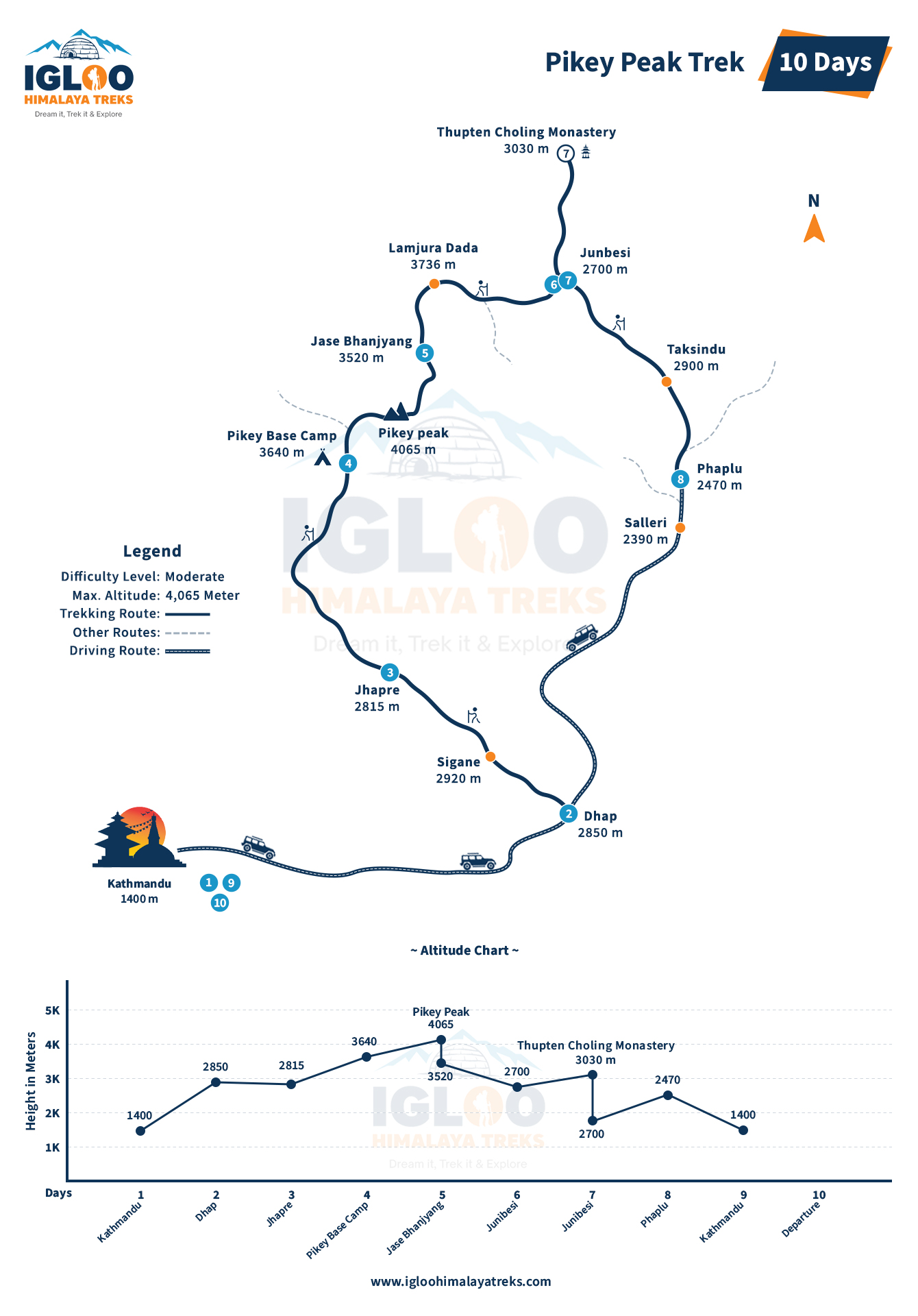
The Pikey Peak trek begins with a road journey from Kathmandu to Dhap Bazaar or Phaplu, a drive of roughly 7 to 8 hours that follows the Sunkoshi River through hills, terraced farmland, and small villages. Along the way, the road passes through Dhulikhel, Khurkot, and Ghurmi, offering early glimpses of Nepal’s countryside before the trekking portion of the journey even begins. Some itineraries instead start from Jiri, the traditional starting point for older Everest region treks. From the road head, whether at Dhap or Phaplu, the trail follows a gradual ascent through pine and rhododendron forest, gently gaining elevation as it moves deeper into the lower Solukhumbu district.
From Dhap, the trail climbs through villages such as Jhapre before reaching Pikey Peak Base Camp, a small settlement that also houses a Swiss established cheese factory supplying yak cheese to shops and restaurants in Kathmandu. This stretch of trail winds through forested ridgelines with occasional clearings that offer early views of the surrounding mountains. From base camp, the final ascent to the summit follows a steep, rocky ridgeline and is usually walked before dawn, allowing trekkers to reach the 4,065 meter summit in time for sunrise over the Himalaya. After taking in the summit views, the trail descends toward Jase Bhanjyang, passing grazing yaks and traditional yak herding shelters, before continuing on to Junbesi, a well known common stop on longer Everest region routes. Junbesi is often used as a base for a short side trip to Thupten Choiling Monastery, located about an hour’s walk from the village.
From Junbesi, the route continues toward Phaplu, passing through forested terrain, smaller settlements, and river crossings, including the Ringmo Khola and Junbesi Khola. Phaplu marks the end of the trekking portion of the route and serves as a small hub with basic services, including the only ATM along the entire trail. Most itineraries conclude with a jeep drive of several hours back to Kathmandu from Phaplu, though some trekkers choose to extend their trip by combining Pikey Peak with additional trails in the lower Everest region. Depending on the operator and chosen variation, the full route covers approximately 50 to 65 kilometers over five to seven days, with longer itineraries extending the trail through additional villages for a more in-depth cultural experience.
Key Things to Know Before You Go To Pikey Peak Trek
Best Time to Visit
● The Pikey Peak falls in May the perfect excuse to plan your trip in spring
● Spring (March-May) and autumn (September-November) offer the best trekking conditions for Pikey Peak Climbing like clear skies, warm days, and great visibility
Power & Charging
● Reliable electricity is not available along most of the trail
● Many teahouses run on solar panels helpful but not guaranteed
● Always carry extra batteries and a fully charged power bank
Accommodation
● Expect ordinary, no-frills teahouse stays for most of the Pikey Peak trek twin bed sharing and common toilets are standard
● Proper rest is very necessary before heading deeper into the region so don’t be shy to ask if there is any requests our guide will help give the best we can
Travel Insurance
● Travel insurance is a must .
● While emergencies are rare in Pikey Peak Climbing, the remote nature of the region means that being unprepared is simply not an option
● Make sure your policy covers high-altitude trekking and emergency evacuation
Physical Preparation
● Pikey Peak trek is easy for regular trekkers
● Start preparing a month in advance with stamina-building exercises, hiking, and running to not feel difficult.
● A strong body and a prepared mind will make huge contribution on surviving the trek and truly enjoying it
● Watch videos of Pikey Peak to understand the difficulties and physical strength needed to enjoy the trek.
Gear & Equipment
● Pikey Peak requires minimal but specific gear
● Essential items include trek/snow boots, thermals, windproof outwear, a down jacket, sunglasses, sun protection, a headlamp, and trekking poles.
Fees, Permits and rules for Pikey Peak Trek
Gaurishankar Conservation Area Project Permit – NPR 3,000 (USD 25)
Sagarmatha National Park Entry Permit – NPR 3,000 (USD 25)
TIMS(Trekkers’ Information Management System) Card = NPR 2,000 (USD 16)
Permits for Pikey Peak and it will be managed by Igloo Himalaya Treks. These fees go toward protecting the wildlife and maintaining the trekking trails in the national park area.
Why Choose Pikey Peak Trek with Igloo Himalaya Treks?
Imagine entering a quiet Himalayan valley, where clouds brush ancient monasteries, sceneries so grand that you never forget and snow peaks rise like silent guardians. You’re not a tourist, you’re an explorer, guided by our team who breathe these mountains. Choose Igloo Himalayan Treks to scoop out the best experience on a trek in Nepal, as we provide:
● A Personal, Heartfelt Journey
This trek isn’t just about mountains, it’s about connecting. With our experienced guides, you’ll go beyond the trail and into the stories, traditions and lives of the Solukhumbu people.
● Small Groups, Big Experience
We keep our groups small so you get personal space to reflect, and real moments of connection with the landscape and culture.
● Sustainability First
Every trek contributes to rebuilding efforts, education, and health initiatives in the Solukhumbu region. Your journey helps uplift the communities you walk through.
● Deep Local Expertise
Our guides have years of experience. They know every turn of the trail, every prayer flag, and every viewpoint. You won’t just see Everest, you’ll feel it.
Highlights
- 360-degree Everest panorama : The summit offers amazing views of Mount Everest, Lhotse, Makalu, Kanchenjunga, and Manaslu, all visible from a single vantage point.
- Sunrise summit views : Trekkers hike up early in the morning to reach the top before sunrise and watch golden light spread across the surrounding peaks.
- Compared to Everest Base Camp or the Annapurna Circuit, Pikey Peak remains a quieter route with significantly fewer trekkers.
- Lower altitude, lower risk At 4,065 meters, the summit carries a much lower risk of altitude sickness than higher Everest region treks, making it accessible to a wider range of trekkers.
- Sherpa culture and monastery visits The trail passes through traditional Sherpa villages and near the historic Thupten Choling Monastery, offering genuine cultural immersion alongside the mountain views.