

Trip Info
-
Kathmandu
-
Private Vehicle / Airplane
-
3-star hotel -Tea House - Lodge
-
Kathmandu-Breakfast, Mountain-Breakfast - Lunch - Dinner
-
5416 m.
Overview
The Classic Annapurna Circuit Trek is a 17-day journey around the Annapurna massif. The trail takes you from the green valleys of central Nepal into the high Himalayan landscapes of Manang.
You will cross the 5,416-meter Thorong La Pass before descending into the dry landscapes of Mustang and the Kali Gandaki Valley.
Along the way, you will walk through Dharapani, Chame, Upper Pisang, Manang, Yak Kharka and Muktinath before continuing to Marpha, Tatopani and Ghorepani.
The changing scenery is one of the trek’s greatest strengths: subtropical forests gradually give way to alpine terrain, high mountain desert and finally lush lower valleys.
The route also brings you close to Gurung, Manangba, Tibetan-influenced and Thakali communities, with monasteries, chortens, prayer walls and traditional villages along the trail.
Our Classic Annapurna Circuit Trek Route
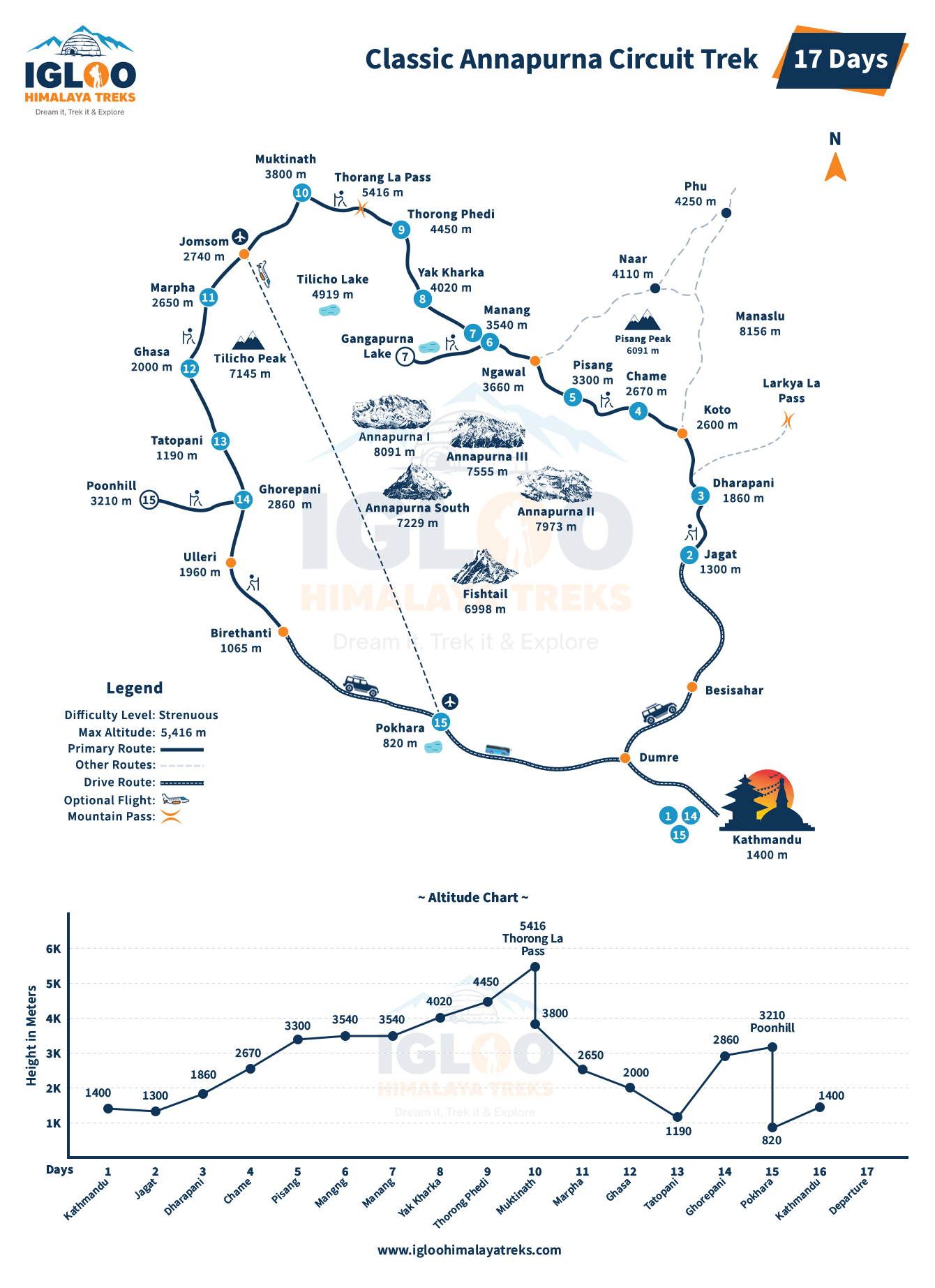
Kathmandu → Jagat → Dharapani → Chame → Upper Pisang → Manang → Yak Kharka → Thorong Phedi → Thorong La Pass → Muktinath → Marpha → Ghasa → Tatopani → Ghorepani → Poon Hill → Birethanti → Pokhara → Kathmandu
This route takes you progressively higher through the Marsyangdi Valley, gives you an acclimatization day in Manang before the high-altitude section, crosses Thorong La, and then descends through Mustang and the Kali Gandaki Valley before finishing with Poon Hill and a comfortable return to Pokhara.
The Annapurna region is particularly known for its dramatic contrast between forested middle mountains and the dry trans-Himalayan landscape north of the main Himalayan range.
Trip Highlights
- Cross Thorong La Pass at 5,416 meters, the highest point of the trek.
- Spend an important acclimatization day in Manang before heading toward the high pass.
- Follow the Marsyangdi River through deep gorges, waterfalls, forests and mountain villages.
- Experience the contrasting landscapes of Manang and Mustang, from green valleys to dry Himalayan terrain.
- Walk through Upper Pisang, Ghyaru and Ngawal, where Tibetan-influenced architecture and mountain culture become increasingly visible.
- Visit Muktinath, a major pilgrimage site revered by both Hindus and Buddhists.
- Explore Marpha, a historic Thakali settlement known for its stone-paved lanes, traditional houses and apple-growing culture.
- Relax in the natural hot springs of Tatopani after the long high-altitude section.
- Enjoy the sunrise from Poon Hill at 3,210 meters, with views toward the Annapurna and Dhaulagiri ranges.
- Experience one of Nepal's most varied trekking routes, where the landscape, climate, architecture and local culture change noticeably from day to day.
Classic Annapurna Circuit Trek Itinerary
Explore our 17-day Annapurna Circuit Trek itinerary from Kathmandu to Thorong La, Muktinath, Mustang, Ghorepani, and Pokhara.
Altitude: 1,350 m
Accommodation: 3-star hotel
Meals: Breakfast
Activity: Airport transfer and trek preparation
Welcome to Nepal. When you arrive at Tribhuvan International Airport, our representative will be waiting to receive you and take you comfortably to your hotel in Kathmandu.
Once you have checked in, you can take the rest of the day at your own pace. If you arrive with enough time, you can explore the nearby streets of Thamel, relax at your hotel, or use the evening to prepare for the days ahead.
Your trek arrangements will already be organized by our team, so you do not need to spend your first day worrying about finding accommodation or sorting out the basic logistics. We will also brief you about the route, what to expect at higher elevations, and any final preparations before you leave Kathmandu.
Overnight: 3-star hotel in Kathmandu.
Altitude: 1,310 m
Distance: Approximately 215 km
Duration: 7–8 hours
Accommodation: Teahouse/lodge
Meals: Breakfast, lunch and dinner
Activity: Scenic mountain drive
After breakfast, we leave Kathmandu and begin the long but scenic drive toward the Annapurna region.
The road gradually leaves the busy Kathmandu Valley and enters the greener countryside of central Nepal. Along the way, you will see terraced farmland, hillside settlements, rivers, suspension bridges and traditional houses.
As the journey continues toward the Marshyangdi Valley, the landscape becomes increasingly mountainous.
Jagat is located along the route toward Manang and marks the point where your walking journey begins the following day.
After reaching the village, your accommodation will already be arranged, allowing you to check in, put your bags down and rest after the drive.
There is no need to spend your evening looking for a room. Simply settle in, enjoy dinner and prepare for your first full day on the trail.
Overnight: Teahouse/lodge in Jagat.
Altitude: 1,855 m
Distance: Approximately 13 km
Duration: 5–6 hours
Accommodation: Teahouse/lodge
Meals: Breakfast, lunch and dinner
Activity: Trekking
Today is the first proper walking day of your Annapurna Circuit Trek.
The trail follows the Marshyangdi River through a greener section of the circuit, with forests, waterfalls, suspension bridges and small settlements along the way. You will pass through Chamje and continue toward Tal, one of the first notable settlements of the Manang section.
As you move farther up the valley, you can begin to notice changes in the architecture and surrounding landscape. Traditional stone houses, prayer flags and Buddhist cultural features become more common as you approach the higher communities.
From Tal, the trail continues toward Dharapani through forests and river valleys. Dharapani is an important settlement on the Annapurna Circuit and also a meeting point for trekkers following the Manaslu and Annapurna routes.
Your room will already be arranged before you arrive. After reaching Dharapani, you can check in, freshen up and relax rather than searching for accommodation after the day's walk.
Overnight: Teahouse/lodge in Dharapani.
Altitude: 2,670 m
Distance: Approximately 14 km
Duration: 5–6 hours
Accommodation: Teahouse/lodge
Meals: Breakfast, lunch and dinner
Activity: Trekking
Today we continue deeper into the Manang District.
The trail climbs gradually through pine and mixed mountain forests, passing settlements and viewpoints along the Marshyangdi Valley. One of the memorable stops is Timang, from where the mountain scenery begins to open considerably on a clear day.
As you continue toward Chame, the valley becomes narrower and the surrounding peaks feel much closer. The landscape is also noticeably different from the lower sections of the trek, with cooler air, conifer forests and increasingly rugged mountain slopes.
Chame is the administrative headquarters of Manang District and one of the larger settlements along the route. Once you arrive, your accommodation will already be waiting. You can check in immediately, rest your legs and, if you feel like exploring, walk around the settlement or visit the nearby hot springs.
Overnight: Teahouse/lodge in Chame.
Altitude: 3,300 m
Distance: Approximately 14 km
Duration: 4–5 hours
Accommodation: Teahouse/lodge
Meals: Breakfast, lunch and dinner
Activity: Trekking
The trail becomes increasingly alpine today as we leave Chame and follow the Marsyangdi River upstream.
The valley narrows dramatically in places, with steep rock walls rising above the river. Pine and fir forests continue to line sections of the trail, while waterfalls and suspension bridges add variety to the walk.
One of the major sights today is Paungda Danda, a huge curved rock face rising dramatically above the valley. It is one of the most recognizable geological features along the Annapurna Circuit.
Eventually, the valley opens and you reach Pisang. The settlement is traditionally divided into Lower Pisang and Upper Pisang, with Upper Pisang sitting higher on the northern side of the valley.
From Upper Pisang, the surrounding mountain views become particularly impressive, including views toward Annapurna II and Pisang Peak.
After reaching Upper Pisang, your room will already be arranged. Check in, rest and take some time to explore the village or visit the local monastery if conditions and time allow.
Overnight: Teahouse/lodge in Upper Pisang.
Altitude: 3,550 m
Distance: Approximately 19 km
Duration: 6–7 hours
Accommodation: Teahouse/lodge
Meals: Breakfast, lunch and dinner
Activity: Trekking
Today is one of the most scenic and culturally interesting days of the entire Annapurna Circuit Trek.
From Upper Pisang, we take the higher route toward Ghyaru and Ngawal rather than simply following the lower valley. The climb is more demanding, but the reward is a much wider perspective of the Annapurna range and the Marsyangdi Valley.
The trail passes ancient stone-built settlements, prayer walls, chortens and Buddhist cultural features. At Ghyaru and Ngawal, you can see how life in the high Manang Valley has developed around a colder, drier Himalayan environment.
After Ngawal, the trail gradually descends toward Manang. The landscape is now noticeably drier, and the mountains and cliffs around the valley become more dramatic.
Manang is one of the most important settlements on the circuit and the perfect place to pause before going higher.
Your accommodation will already be organized before your arrival. Once you reach Manang, you can check in, rest and enjoy the evening without having to search for a room.
Overnight: Teahouse/lodge in Manang.
Altitude: 3,550 m
Hiking: Approximately 3–4 hours
Accommodation: Teahouse/lodge
Meals: Breakfast, lunch and dinner
Activity: Acclimatization hike
Today is not simply a rest day. It is an important part of your high-altitude acclimatization before we continue toward Yak Kharka, Thorong Phedi and Thorong La.
After breakfast, we take a short hike around the Manang area. Depending on conditions and the group's pace, you can explore places such as Gangapurna Lake, viewpoints around the valley or nearby cultural sites.
Gangapurna Lake is formed from glacial meltwater and sits beneath the dramatic mountain landscape surrounding Manang. The surrounding area gives you a good opportunity to walk at altitude without gaining too much additional elevation.
You can also spend time exploring Manang's narrow lanes, teahouses and traditional buildings.
The settlement provides an interesting look into the high-altitude lifestyle of the region, where Tibetan Buddhist cultural influences are particularly strong.
The purpose of today's hike is to stay active while giving your body time to adjust to the altitude. We keep the pace comfortable and return to Manang for another night.
Overnight: Teahouse/lodge in Manang.
Altitude: 4,045 m
Distance: Approximately 11 km
Duration: 3–4 hours
Accommodation: Teahouse/lodge
Meals: Breakfast, lunch and dinner
Activity: Trekking
After acclimatizing in Manang, we continue toward the higher section of the Annapurna Circuit.
The trail leaves the main settlement and enters a much more open Himalayan landscape. Trees become increasingly sparse as the elevation rises, while alpine grasslands and exposed mountain slopes dominate the scenery.
The route passes through smaller settlements and grazing areas where yaks and other livestock are commonly seen. You will also notice that the landscape is considerably drier than the forested valleys below.
Yak Kharka is a high-altitude pasture settlement used traditionally for livestock grazing. The shorter walking distance today is intentional, giving your body more time to adjust before the Thorong La section.
When you arrive, your accommodation will already be arranged. Settle into the teahouse, stay warm, hydrate well and take it easy for the remainder of the day.
Overnight: Teahouse/lodge in Yak Kharka.
Altitude: 4,445 m
Distance: Approximately 8 km
Duration: 3–4 hours
Accommodation: Teahouse/lodge
Meals: Breakfast, lunch and dinner
Activity: Trekking
Today takes us to Thorong Phedi, the final major overnight stop before crossing Thorong La Pass.
Although the distance is relatively short, the increasing altitude makes this section more demanding than the lower parts of the circuit. The trail climbs gradually through exposed mountain terrain, with fewer trees and increasingly rugged slopes.
As we approach Thorong Phedi, the surrounding landscape becomes stark and impressive. The settlement sits beneath the massive slopes leading toward Thorong La, giving you a clear sense of what lies ahead.
This is a good day to organize your backpack for the following morning. Keep the things you need for the pass easily accessible, stay hydrated and follow your guide's advice regarding altitude and the next day's early start.
Your accommodation will already be prepared at Thorong Phedi, so once you arrive, you can check in, rest and have an early dinner.
Overnight: Teahouse/lodge in Thorong Phedi.
Highest Point: 5,416 m at Thorong La Pass
Destination Altitude: 3,800 m
Distance: Approximately 15 km
Duration: About 8 hours
Accommodation: Teahouse/lodge
Meals: Breakfast, lunch and dinner
Activity: Thorong La Pass crossing
Today is the defining day of your Classic Annapurna Circuit Trek.
We start early from Thorong Phedi because crossing Thorong La Pass at 5,416 meters requires a long day and careful pacing.
The climb is steady, and the thin air means you should not rush. Our guide will help maintain a comfortable pace and monitor how everyone is feeling.
As you climb higher, the landscape becomes increasingly barren and expansive. Eventually, the prayer flags marking Thorong La come into view. Reaching the pass is a major achievement and one of the most memorable moments of the entire circuit.
Thorong La is the highest point of this itinerary and one of the major high passes of the Himalayas. The Annapurna region is known for this dramatic transition between the Marsyangdi side and the Kali Gandaki/Mustang side of the range.
After celebrating the crossing, we begin the long descent toward Muktinath. The change in landscape is remarkable: high exposed slopes give way to the sacred pilgrimage area of Muktinath.
Muktinath is important to both Hindu and Buddhist pilgrims. The area includes the Muktinath temple complex, Jwala Mai temple with its natural flame and 108 sacred water spouts.
After this demanding day, your accommodation will already be arranged in Muktinath. You can check in, have dinner and finally rest after crossing the highest point of the trek.
Overnight: Teahouse/lodge in Muktinath.
Altitude: 2,580 m
Distance: Approximately 22 km
Duration: 5–6 hours
Accommodation: Teahouse/lodge
Meals: Breakfast, lunch and dinner
Activity: Trekking
Today we leave the high-altitude environment of Muktinath and descend through Mustang and the Kali Gandaki Valley.
The descent brings another dramatic change in scenery. The barren slopes and high Himalayan terrain gradually give way to warmer valleys and more vegetation. We pass through Jomsom, the administrative center of Mustang and an important settlement in the Kali Gandaki corridor.
From Jomsom, we continue toward Marpha, one of the best-known Thakali villages in the region.
Marpha is particularly recognizable for its whitewashed houses, stone-paved lanes, wooden details and apple orchards.
The village has a strong Thakali cultural identity and has long been associated with trade and agriculture in the Kali Gandaki Valley.
Once you arrive, your accommodation will already be arranged. After checking in, you can walk through Marpha's narrow lanes, visit the local monastery or simply relax in the village atmosphere.
Overnight: Teahouse/lodge in Marpha.
Altitude: 2,040 m
Distance: Approximately 26 km
Duration: 6–7 hours
Accommodation: Teahouse/lodge
Meals: Breakfast, lunch and dinner
Activity: Trekking
Today we continue south through the Kali Gandaki Valley.
The trail passes through traditional settlements including Tukuche and Larjung, where Thakali culture remains an important part of local life. The landscape continues to change as we lose elevation.
Compared with the dry environment around Muktinath and Marpha, vegetation becomes increasingly abundant. Forests begin to return, and the valley feels warmer and greener.
The Kali Gandaki corridor is one of the defining geographical features of the Annapurna region, lying between the Annapurna and Dhaulagiri massifs. Nepal Tourism Board describes the valley between these two major mountain groups as one of the world's deepest gorges.
Eventually, we reach Ghasa, where the environment is considerably greener than the high country we experienced only a few days earlier.
Your accommodation will already be waiting in Ghasa, allowing you to check in and rest immediately after the long walking day.
Overnight: Teahouse/lodge in Ghasa.
Altitude: 1,190 m
Distance: Approximately 19 km
Duration: 5–6 hours
Accommodation: Teahouse/lodge
Meals: Breakfast, lunch and dinner
Activity: Trekking
The descent continues today as we move deeper into the lower Kali Gandaki Valley.
The landscape becomes greener and warmer, with forests, streams, waterfalls and cultivated hillsides replacing the dry high-altitude terrain. The contrast is one of the reasons the Annapurna Circuit Trek is so distinctive: within a matter of days, you can experience environments ranging from alpine desert to lush subtropical valleys.
The route passes through villages and forested sections before reaching Tatopani, whose name literally refers to hot water.
After several demanding days in the high mountains, Tatopani provides an excellent opportunity to slow down. The village is famous for its natural hot springs, where trekkers commonly relax and soak their tired muscles.
Once we arrive, your accommodation will already be arranged. After checking in, you can rest and, if you wish, enjoy time at the hot springs.
Overnight: Teahouse/lodge in Tatopani.
Altitude: 2,860 m
Distance: Approximately 18 km
Duration: 6–7 hours
Accommodation: Teahouse/lodge
Meals: Breakfast, lunch and dinner
Activity: Trekking
Today we leave the Kali Gandaki Valley and begin a sustained climb toward Ghorepani.
The route passes through forests and traditional settlements as the trail gains elevation. Depending on the season, the surrounding hills can be particularly colourful with rhododendron blooms. Nepal Tourism Board identifies rhododendron forests as one of the characteristic features of the Annapurna region.
The higher we climb, the cooler the air becomes and the more expansive the mountain views can be. Eventually, we reach Ghorepani, a well-known trekking settlement positioned on a ridge with views toward the Annapurna and Dhaulagiri ranges.
Your accommodation will already be arranged in Ghorepani. After checking in, have dinner and prepare for an early morning because tomorrow begins before sunrise.
Overnight: Teahouse/lodge in Ghorepani.
Poon Hill Altitude: 3,210 m
Trek Duration: Approximately 6 hours
Drive: Approximately 1.5 hours
Accommodation: 3-star hotel in Pokhara
Meals: Breakfast and lunch
Activity: Sunrise hike, trekking and drive
We begin before sunrise for the final major viewpoint of the trek: Poon Hill.
The early climb takes us through rhododendron and oak forests toward the viewpoint. As daylight begins to spread across the mountains, the surrounding peaks gradually become visible. On a clear morning, you can see the Annapurna and Dhaulagiri ranges illuminated by the first sunlight.
After spending time at Poon Hill, we descend to Ghorepani for breakfast before continuing downhill toward Birethanti.
This final trekking section feels very different from the high mountain trails earlier in the journey. The path passes through greener forests, villages, terraces and lower-elevation landscapes.
At Birethanti, our vehicle will meet you for the drive to Pokhara.
When you reach Pokhara, your hotel will already be arranged. You can check in, take a proper shower, rest comfortably or head out to enjoy the lakeside area. After many days on the trail, this is your chance to slow down and enjoy Pokhara.
Overnight: 3-star hotel in Pokhara.
Distance: Approximately 203 km
Duration: 6–7 hours
Accommodation: 3-star hotel
Meals: Breakfast
Activity: Scenic drive
After breakfast, we leave Pokhara and drive back toward Kathmandu.
The route passes through the hills and river valleys of central Nepal, with terraced farmland, roadside settlements and changing views along the journey. Depending on road and traffic conditions, we will make suitable stops along the way so you can stretch your legs and have refreshments.
After arriving in Kathmandu, you can check into your hotel and spend the rest of the afternoon relaxing or exploring the city.
If you still have energy, Thamel is an easy place to spend your final evening, whether you want to shop for souvenirs, enjoy a meal or simply walk around after completing the circuit.
Your Kathmandu accommodation is already arranged, so you can return to the hotel and relax without needing to organize anything yourself.
Overnight: 3-star hotel in Kathmandu.
Activity: Airport transfer
Meals: Breakfast
Your Classic Annapurna Circuit Trek officially comes to an end today.
Depending on your flight schedule, you can enjoy your final breakfast at the hotel before our representative transfers you to Tribhuvan International Airport for your onward journey.
Our team will assist you with the departure arrangements and make sure you reach the airport on time.
We hope the journey through the Marsyangdi Valley, Manang, Thorong La, Mustang, the Kali Gandaki Valley and Ghorepani leaves you with memories you will carry long after you leave Nepal.
Trip ends with airport transfer.
Includes
- All ground transportation including airport pick-up and drop-off
- Two nights’ accommodation in Kathmandu and one night in Pokhara at a 3-star category hotel with breakfast (BB plan)
- All standard meals during the trek breakfast, lunch, and dinner with tea or coffee (fresh fruits with dinner)
- Accommodation in the best available Teahouse lodge throughout the trekking route
- Experienced, licensed English-speaking trekking guide for the entire trip
- Strong and reliable porter to carry your trekking luggage (one porter shared between two trekkers)
- Comprehensive first aid medical kit carried by the guide for emergency use
- All necessary permits and documentation required for the Classic Annapurna Circuit Trek
- Trekking essentials duffel bag,sleeping bag down jacket (return after trek ) detailed trekking map, and trip achievement certificate
- All applicable government taxes and official service charges
- Arrangement of emergency helicopter services paid by your travel insurance company
Excludes
- Emergency travel insurance
- International air fare, Nepal visa fee
- Lunch and dinner in Kathmandu and Pokhara
- Extra expenses such as drinking water, shower, desserts, extra meals, Wi-Fi, device charging, upgraded accommodation.
- Tips for trekking staffs
Frequently Asked Questions
General
The classic itinerary typically takes 17 days, allowing proper acclimatization and a comfortable pace while covering major cultural and natural highlights.
The highest point is Thorong La Pass (5,416m)—one of the world’s highest trekking passes.
It is considered moderate to challenging. The hike is not technical, but long walking days, high altitude, and steep climbs require good fitness and strong determination.
Yes, especially near Manang and Thorong La. The 17-day itinerary includes proper acclimatization days, gradual elevation gain, and guidance from experienced Igloo Himalaya Treks leaders to reduce risk.
The trek uses comfortable teahouses and lodges with clean rooms, warm dining halls, hot meals, and Wi-Fi available in many places.
You can enjoy Nepali, Tibetan, and international meals such as dal bhat, pasta, soups, fried rice, pancakes, noodles, pizza and more. We ensure hygienic meals throughout the journey.
Trekkers should have basic to moderate fitness with the ability to walk 5–7 hours daily. Prior hiking experience is helpful but not mandatory.
Yes. Igloo Himalaya Treks provides experienced licensed guides and friendly porters who ensure safety, navigation, and comfort throughout the trek.
Local expert guides
Safety-focused itineraries
Tailor-made services
Genuine hospitality
Support Your journey becomes more meaningful, comfortable, and memorable with our experienced team.
Trekkers need the required Annapurna Conservation Area Permit (ACAP) and other applicable trekking documentation for the route. You do not need to arrange these permits yourself—Igloo Himalaya Treks handles the required permits and documentation before your trek. For the latest official requirements, you can also check the Nepal Department of Immigration.
Map
Accommodation on the Classic Annapurna Circuit Trek
Accommodation is arranged throughout the trek so you do not have to search for a room after reaching each destination.
We use the best available teahouse or lodge along the route, with rooms generally offering basic beds and shared bathroom facilities in the higher trekking areas.
In Kathmandu and Pokhara, the package includes 3-star category hotel accommodation with breakfast. During the mountain section, teahouses provide the practical comfort needed after a day on the trail.
Because accommodation availability can vary by season and village, the exact teahouse may change.
Our team handles the arrangements so that when you arrive at your destination, you can check in, put down your backpack and rest rather than spending your evening looking for a room.
Food and Meals During the Trek
Your trekking package includes breakfast, lunch and dinner with tea or coffee, with fresh fruit included with dinner according to the current package inclusions.
Food along the Annapurna Circuit is generally simple, filling and designed to keep trekkers fueled for long walking days. Dal bhat remains one of the most practical choices because it combines rice, lentils, vegetables, curry and pickles, and many teahouses offer additional servings when available.
You can also find dishes such as:
- Tibetan bread
- Chapati
- Eggs
- Porridge
- Noodles
- Fried rice
- Pasta
- Momo
- Soups
- Potatoes
- Seasonal vegetables
If you have a specific food preference, dietary requirement or allergy, let us know before the trek. We can discuss the available options and make the necessary arrangements as far as the facilities along the route allow.
What We Provide for Your Trek
We take care of the major trekking logistics so you can focus on the journey.
Your package includes:
- Experienced, licensed English-speaking trekking guide
- Porter service, with one porter shared between two trekkers
- Annapurna trekking permits and required documentation
- Teahouse/lodge accommodation during the trek
- Kathmandu and Pokhara hotel accommodation
- Breakfast, lunch and dinner during the trek
- Airport transfers and required ground transportation
- Trekking duffel bag
- Sleeping bag
- Down jacket
- Detailed trekking map
- First-aid medical kit carried by the guide
- Trip achievement certificate
- Government taxes and official service charges
- Emergency helicopter arrangement, with costs handled through your travel insurance where applicable.
You therefore do not need to purchase or carry every trekking item yourself. The sleeping bag, down jacket and duffel bag are provided by our team and returned after the trek.
If you are unsure about any trekking gear or have a particular preference, feel free to consult our team before your trip. We can guide you on what you actually need to bring and help arrange the necessary trekking essentials.
Trekking Permits and Documentation
The Annapurna Circuit passes through the Annapurna Conservation Area, and the required trekking documentation must be arranged before entering the trekking area.
Nepal Tourism Board identifies the Annapurna Conservation Area as a protected trekking region covering parts of Kaski, Lamjung, Manang and Mustang.
You do not need to spend your trip navigating the permit process yourself. Our team handles the necessary permits and trekking documentation for you as part of the organized trek.
The exact permit requirements and fees can change according to government regulations, so we verify the current requirements when arranging your trek rather than asking you to rely on outdated information.
Nepal’s Department of Immigration also maintains official trekking-permit services and current permit information.
Annapurna Circuit Trek Difficulty
The Classic Annapurna Circuit Trek is a moderate to challenging high-altitude trek. You do not need previous mountaineering experience, but you should be prepared for several consecutive days of walking, significant elevation gain and the demanding crossing of Thorong La at 5,416 meters.
The difficulty comes from several factors:
Long Walking Days
Most trekking days involve several hours of walking, with some days covering considerable distances. The body needs to adapt not only to the trail but also to repeated days of physical activity.
High Altitude
Altitude becomes the most important consideration after Manang. The itinerary includes an acclimatization day at Manang before moving toward Yak Kharka and Thorong Phedi.
Thorong La Crossing
The highest and most demanding day is the crossing from Thorong Phedi to Muktinath via 5,416-meter Thorong La Pass. Starting early, walking slowly and following your guide’s instructions are important.
Changing Terrain
You will experience forest trails, stone paths, suspension bridges, rocky mountain terrain, exposed high-altitude trails and long descents.
With appropriate preparation, a sensible pace and good acclimatization, the trek is achievable for many reasonably fit trekkers.
Altitude and Acclimatization
Altitude is something to take seriously on the Annapurna Circuit because the route rises from relatively low valleys to more than 5,400 meters.
The itinerary includes an acclimatization day in Manang at around 3,550 meters before continuing toward Yak Kharka and Thorong Phedi. This gives your body additional time to adjust before the highest section.
During the trek, our guide monitors the group and can advise you if you experience symptoms that may indicate altitude sickness.
Do not try to push through serious altitude symptoms. Tell our guide immediately if you feel unusually unwell, particularly if you develop severe headache, vomiting, confusion, difficulty walking or breathing problems.
Best Time for the Classic Annapurna Circuit Trek
The best times for the Classic Annapurna Circuit are spring (March–May) and autumn (September–November), when days are clear, trails are dry, and mountain views are at their most rewarding.
Within these windows, October and April are widely regarded as the standout months for stable weather, comfortable temperatures, and excellent visibility over the Annapurna and Dhaulagiri ranges.
Spring (March–May): Colour, warmth and long days
Spring is ideal if you love blooming forests, longer daylight, and a lively trail atmosphere.
- March: Days are crisp and clear, with rhododendrons beginning to flower at lower and mid-elevations. Thorong La is generally open, and mornings are cold but stable, great for an early pass crossing.
- April: Often the most colourful month. Rhododendron forests between Tatopani Ghorepani and along the lower approaches are in full bloom, while skies stay mostly clear. Daytime temps are mild in the valleys (around 12–20°C) and manageable at altitude, making April one of the most comfortable spring months for the full circuit.
- May: Warmer days and lush green hillsides. The upper circuit remains very scenic, and Thorong La is snow-free. Lower valleys can feel hazy later in the month, but higher sections still offer strong views.
Typical spring conditions
- Lower elevations (Besisahar–Chame): ~10–25°C by day, cooler at night.
- Mid/high elevations (Manang–Thorong La area): roughly 0–10°C by day in the higher sections, colder before sunrise on pass day.
Spring is especially good for first-time trekkers who want a balance of reliable weather, vivid landscapes, and full teahouse services.
Autumn (September–November): Crisp air and big-mountain views
Autumn is the classic “post-monsoon clarity” season, with stable skies and some of the year’s best mountain panoramas.
- September: The landscape is fresh and green after the rains, with clearing skies as the month progresses. Days are pleasant in the valleys; nights get chilly at altitude.
- October: Traditionally the most popular month. Days are sunny and stable, visibility is excellent, and temperatures are comfortable for long walking days. This is the top choice if your priority is big, clear views of Annapurna, Dhaulagiri, Manaslu, and the surrounding peaks.
- November: Cooler and quieter, with very clear air. Days remain trekking-friendly, while nights, especially around Thorong La and High Camp, get quite cold, so good layers are important.
Typical autumn conditions
- Lower to mid-elevations: roughly 10–24°C by day, cooler at night.
- High sections (Thorong La corridor): often around −5 to 8°C by day depending on the month, with very cold pre-dawn starts on pass day.
Autumn suits trekkers who prioritise maximum visibility, stable weather, and classic Himalayan postcard views.
Month-by-month quick guide (highlights only)
- March: Clear skies, early blooms, fewer crowds than April.discoveryworldtrekking+1
- April: Peak rhododendron colour, warm days, excellent pass conditions.
- May: Warmest spring month, green valleys, still-good high views.
- September: Fresh landscapes, clearing skies, comfortable trekking.
- October: Best overall clarity and stability; busiest month.
- November: Very clear, cooler and quieter; great for photography and solitude.
Summer / Monsoon (June–August) — rain-shadow magic, green valleys, quiet trails
The Annapurna Circuit is special in monsoon because the northern sections (Manang, Mustang, Muktinath) sit in a rain-shadow and stay much drier than the rest of Nepal.
- June: Start of monsoon. Lower valleys get rain and lush greenery, while Manang and Mustang stay relatively dry with cool, clear days. Great if you want quiet trails and dramatic cloud-framed peaks.
- July: Peak monsoon in the lowlands, but the upper circuit (Manang–Thorong La–Muktinath) is among the driest high-altitude trekking zones in Nepal in this month. Landscapes are vivid, waterfalls are powerful, and teahouses are relaxed.
- August: Rain begins to ease towards the end of the month. Upper sections remain dry and trekable; lower valleys are very green and full of life. Good choice if you want solitude and don’t mind some cloud cover in the lower parts.
Typical monsoon conditions
- Lowlands (Besisahar–Chame): ~20–30°C by day, humid, regular rain.
- Rain-shadow high sections (Manang–Mustang): ~8–15°C by day, often clear or partly cloudy, minimal rain.
Best for: avoiding crowds, experiencing the rain-shadow desert landscapes of Manang/Mustang, seeing the region at its greenest, flexible trekkers who prioritise upper-circuit scenery.
Winter (December–February) — snow, silence, crystal-clear skies
Winter turns the high circuit into a quiet, snowy, high-desert adventure with very clear skies and far fewer people.
- December: Early December often brings clear, cold days and good pass conditions. Snow starts to build later in the month, creating a beautiful winter landscape around Manang, Thorong La and Mustang.
- January: The coldest month, with deep snow possible on higher sections and Thorong La. Perfect if you love true winter mountain vibes, frozen waterfalls, snow-covered monasteries, and empty trails. Many trekkers focus on the rain-shadow sections (Manang–Mustang) for a stunning, serene experience.
- February: Weather begins to stabilise. Skies are bright blue, snow starts to melt and pack down, and late February can feel like early spring at lower elevations while still keeping that crisp winter clarity up high.
Typical winter conditions
- Lower regions: roughly 10–15°C by day, cold nights.
- High altitude (Manang, Thorong La, Mustang): daytime can be around −1 to 10°C depending on sun and wind; nights can drop well below freezing, especially in January.
Best for: solitude, snow scenery, photography in clear winter light, trekkers who enjoy cold but rewarding conditions and quieter teahouses.
Picking your “best” time
- For flowers and colour: late March–April.
- For the clearest mountain views: mid-October–early November.
- For a balance of comfort, views and atmosphere: April or October.
What to Pack for the Annapurna Circuit Trek
You do not need to carry your entire life in your backpack. Pack according to the actual conditions you will encounter.
Essential Clothing
- Moisture-wicking base layers
- Fleece or warm mid-layer
- Waterproof and windproof jacket
- Trekking trousers
- Warm down or insulated jacket
- Thermal underwear
- Warm hat and gloves
- Sun hat or cap
Footwear
- Comfortable, broken-in trekking boots
- Lightweight camp shoes or sandals
- Several pairs of trekking socks
Personal Items
- Sunglasses
- Sunscreen
- Reusable water bottle
- Headlamp
- Personal toiletries
- Small personal first-aid supplies
- Power bank
- Passport and required travel documents
Trekking Gear
We igloo himalaya treks provide a sleeping bag, down jacket and trekking duffel bag, so you do not need to purchase these specifically for the trek.
If you already have preferred trekking equipment or are unsure whether a particular item is necessary, consult our team before departure. We can help you prepare a practical packing list based on the season and your needs.
Is the Classic Annapurna Circuit Trek Suitable for Beginners?
Yes, beginners with reasonable fitness can complete the Classic Annapurna Circuit Trek, but it should not be treated as an easy hike.
The main challenge is the combination of consecutive walking days, elevation gain and the Thorong La crossing. Previous high-altitude trekking experience is helpful but not essential if you prepare properly.
A few weeks of regular walking, hiking, stair climbing or cardiovascular exercise before the trek can make the experience considerably more comfortable.
Our guides also help maintain a suitable pace and monitor the group as we move into higher elevations.
Why Trek the Classic Annapurna Circuit with Igloo Himalaya Treks?
The Annapurna Circuit is not simply about reaching Thorong La. The value of the journey comes from experiencing the entire transition from the lower valleys to the high Himalayas and back down again.
With Igloo Himalaya Treks, we take care of the major logistics before and during your journey, including accommodation, permits, transportation, guides, porters and trekking essentials. That means you can spend less time worrying about logistics and more time enjoying the trail.
Your accommodation is arranged ahead of time, the required permits and documentation are handled by our team, and essential items such as a sleeping bag, down jacket and duffel bag are provided.
If you have specific preferences regarding food, trekking equipment, accommodation, or other arrangements, you can consult with Igloo Himalaya Treks before your trek. We will be happy to discuss your requirements and help arrange what is practical for your journey.
With the right preparation and support, the Classic Annapurna Circuit Trek lets you focus on the adventure while we take care of the essential arrangements along the way.