

-
5 Star - Yati Mountain Home - Tea House
-
Private Vehicle - Airplane
-
5545 m.
-
Kathmandu-Breakfast, Mountain-Breakfast - Lunch - Dinner
Overview
The Everest Base Camp Trek Luxury is a premium Himalayan adventure designed for travelers seeking the thrill of high-altitude trekking combined with unmatched comfort. This 14-day journey allows trekkers to explore the heart of the Khumbu region while staying in luxurious lodges and five-star hotels along the route. From the bustling streets of Kathmandu to the serene landscapes of the Everest region, the trek offers a perfect balance of adventure, culture, and relaxation.
Travelers begin their journey with a scenic flight to Lukla, passing snow-capped peaks and glacial valleys. Along the trail, you will visit traditional Sherpa villages, encounter vibrant Buddhist monasteries, and learn about the unique lifestyle and culture of the mountain communities. Key highlights include exploring Tengboche Monastery with its iconic 20-foot Buddha statue, witnessing the magnificent Khumbu Icefall, and trekking through the rugged Khumbu Glacier.
The trek also includes an ascent of Kalapatthar (5,555 m), offering some of the most breathtaking views of Mount Everest and surrounding peaks, making it a truly unforgettable experience. Unlike standard treks, this luxury itinerary ensures comfort with well-appointed lodges, hot showers, heated rooms, and premium accommodations at every stage of the journey.
Whether you are a seasoned trekker or seeking your first Himalayan adventure, the Everest Base Camp Luxury Trek delivers both adventure and comfort, making it an ideal choice for couples, families, and small groups of friends. The itinerary also allows for optional customization, including extra sightseeing, adventure activities, or extended stays in Nepal before or after the trek.
Our Luxury Everest Base Camp Trek Route
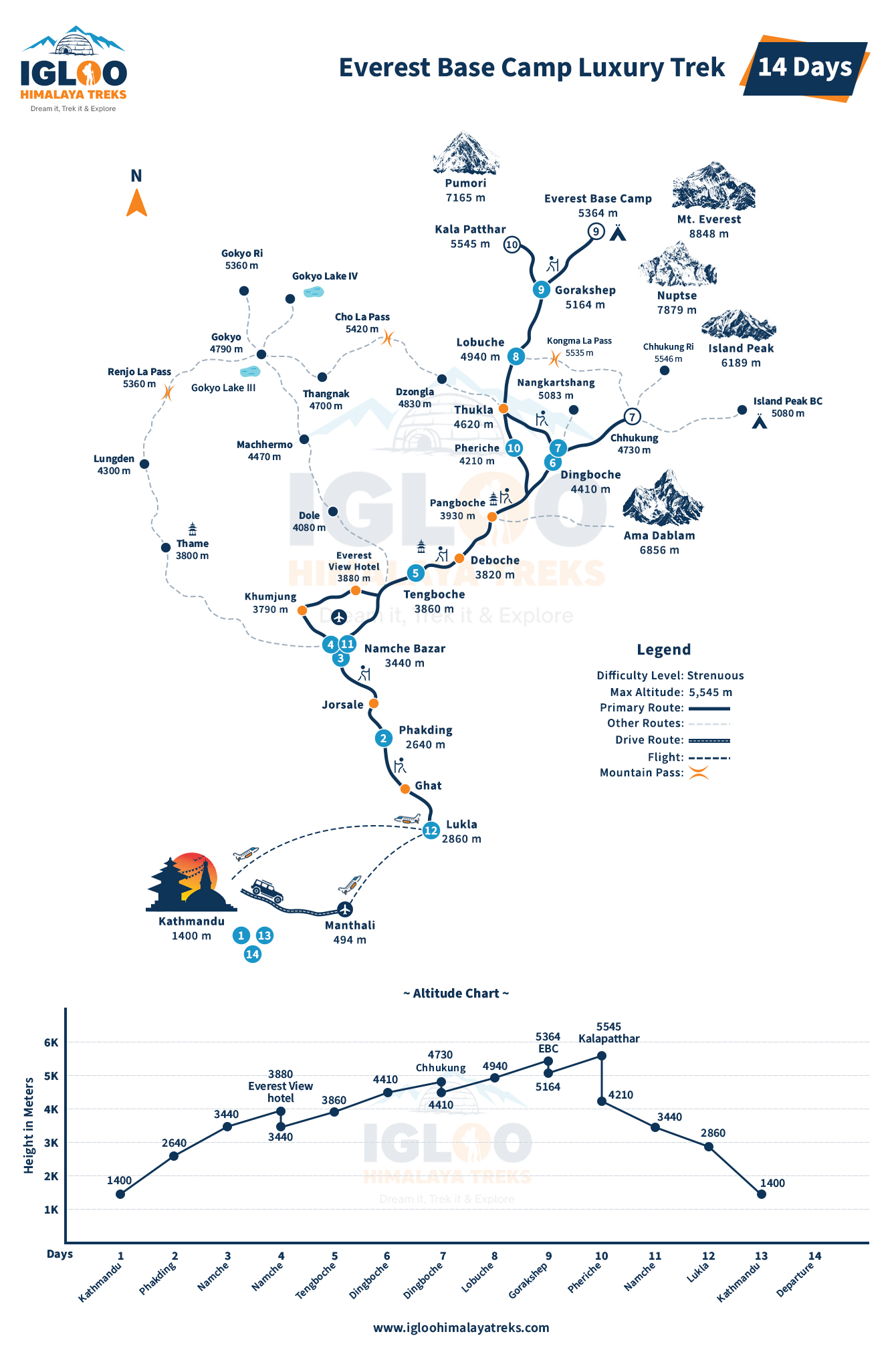
Kathmandu → Lukla → Phakding → Namche Bazaar → Tengboche → Debuche → Dingboche → Lobuche → Gorak Shep → Everest Base Camp → Kala Patthar → Pheriche → Namche Bazaar → Lukla → Kathmandu
Key Highlights
- A thrilling scenic flight between Kathmandu and Lukla with panoramic Himalayan views.
- Visit Tengboche Monastery and explore its intricate wall hangings, Buddha statue, and sacred artifacts of the Lamas.
- Visit Tengboche Monastery and explore its intricate wall hangings, Buddha statue, and sacred artifacts of the Lamas.
- Walk on the Khumbu Glacier and witness the Khumbu Icefall, a unique and dramatic landscape.
- Ascend Kalapatthar (5,555 m) for an unmatched sunrise view over Mount Everest and surrounding peaks.
- Stay in luxury lodges and guesthouses along the trekking route, with heated rooms, hot showers, and premium amenities.(except Dingbuche,Labuche Gorakshep)
- Opportunity to combine cultural exploration in Kathmandu with high-altitude trekking for a complete Himalayan experience.
Everest Base Camp Trek Luxury Itinerary
Explore our 14-day Everest Base Camp Luxury Trek itinerary, from the premium hotels of Kathmandu to the Sherpa villages, monasteries, glaciers, Everest Base Camp, and Kala Patthar.
| Day | Route | Altitude | Walking / Travel |
| 1 | Arrival in Kathmandu | 1,400 m | Airport transfer |
| 2 | Fly to Lukla → Phakding | 2,610 m | 3–4 hr trek |
| 3 | Phakding → Namche Bazaar | 3,440 m | 5–6 hr |
| 4 | Acclimatization in Namche | 3,880 m viewpoint | 4–5 hr hike |
| 5 | Namche → Tengboche → Debuche | 3,830 m | 5–6 hr |
| 6 | Debuche → Dingboche | 4,410 m | 5–6 hr |
| 7 | Acclimatization in Dingboche → Chhukung | 4,730 m | 4–5 hr |
| 8 | Dingboche → Lobuche | 4,910 m | 5–6 hr |
| 9 | Lobuche → Everest Base Camp → Gorak Shep | 5,364 m | 8–9 hr |
| 10 | Kala Patthar → Pheriche | 5,555 m / 4,240 m | 7–8 hr |
| 11 | Pheriche → Namche Bazaar | 3,440 m | 6–7 hr |
| 12 | Namche → Lukla | 2,840 m | 6–7 hr |
| 13 | Fly Lukla → Kathmandu / Ramechhap | 1,400 m | Flight + transfer |
| 14 | Final Departure | — | Airport transfer |
Upon arrival at Tribhuvan International Airport in Kathmandu (1,400 m / 4,593 ft), our team will warmly welcome you and transfer you to a five-star hotel. The day is reserved for rest and adjustment to the city’s altitude. Later, you will attend a pre-trek briefing covering itinerary details, safety instructions, and trekking permits. Make sure to carry passport-sized photos, a copy of travel insurance, and necessary identification documents, as these are required for processing trekking permits and other official documentation. Kathmandu, the capital city, is a vibrant blend of ancient culture and modern lifestyle. If time permits, a short city stroll can introduce you to local markets and stunning architecture.
Accommodation: Five-star hotel
Meals: Breakfast included
Wake up early for a breathtaking flight from Kathmandu to Lukla (2,840 m / 9,318 ft). During peak seasons, flights may depart from Ramechhap (Manthali), requiring a 5–6 hour scenic drive, followed by a 20-minute mountain flight. After meeting your porters, trek along the Dudh Koshi River to Phakding (2,610 m / 8,563 ft). The trail passes through pine forests, traditional villages, and suspension bridges adorned with prayer flags. This initial trek helps you adjust to the altitude gradually while enjoying the serenity of the Khumbu region.
Trekking Distance: 8 km / 5 mi
Duration: 3-4 hours
Accommodation: Yati Mountain Home
Meals: Breakfast, Lunch, Dinner
The trail becomes steeper as you enter Sagarmatha National Park. Cross multiple suspension bridges over the Dudh Koshi River and experience the lively Sherpa culture along the way. Namche Bazaar (3,440 m / 11,286 ft), often referred to as the gateway to Everest, is a bustling town with restaurants, cafes, souvenir shops, bakeries, and internet access. Take time to interact with locals and observe daily life in a high-altitude mountain town while enjoying panoramic views of Ama Dablam, Thamserku, and other peaks along the route.
Trekking Distance: 12.3 km / 7.64 mi
Duration: 5-6 hours
Accommodation: Yati Mountain Home
Meals: Breakfast, Lunch, Dinner
Spend the day acclimatizing to prevent altitude sickness. Hike to Hotel Everest View (3,880 m / 12,730 ft) for panoramic views of Everest, Lhotse, and Ama Dablam, especially beautiful at sunrise. Explore local museums or cultural centers in Namche Bazaar, learning about Sherpa history and experiencing regional hospitality. Gentle hikes around Namche also help your body adapt to thinner air.
Trekking Distance: 7.2 km / 4.47 mi
Duration: 4-5 hours
Accommodation: Yati Mountain Home
Meals: Breakfast, Lunch, Dinner
Follow the Dudh Koshi River upstream through forests, crossing suspension bridges and small villages. Visit Tengboche Monastery, marvel at its ornate wall hangings, 20-foot Buddha statue, and ceremonial robes and musical instruments of the Lamas. Witness a short prayer ceremony if timing allows, then continue to Debuche (3,830 m / 12,639 ft), a traditional Sherpa settlement with incredible views of Ama Dablam and the surrounding ridges.
Trekking Distance: 11.9 km / 7.64 mi
Duration: 5-6hours
Accommodation: Lodge with shared toilet & bathroom
Meals: Breakfast, Lunch, Dinner
The trail gradually ascends to Dingboche (4,410 m / 14,469 ft), a village surrounded by majestic peaks including Lhotse, Island Peak, and Ama Dablam. The village’s stone-built lodges and terraced fields create a picturesque setting. Hiking at a slow, steady pace is important to prevent altitude sickness. Observe prayer flags and small mani walls reflecting Sherpa spiritual culture.
Trekking Distance: 11.1 km / 7.25 mi
Duration: 5-6 hours
Accommodation: Lodge with shared toilet & bathroom
Meals: Breakfast, Lunch, Dinner
Enjoy another acclimatization day with a short hike to Chhukung (4,730 m / 15,518 ft). The trek follows the Imja Khola Valley, providing close-up views of Lhotse’s south face. Excellent photography opportunities await, while helping your body adapt to higher altitudes. Return to Dingboche in the evening for rest and warm meals.
Trekking Distance: 10.5 km / 6.52 mi
Duration: 4-5 hours
Accommodation: Lodge with shared toilet & bathroom
Meals: Breakfast, Lunch, Dinner
Follow the lateral moraine of the Khumbu Glacier, passing memorials for climbers who have lost their lives. Reach Lobuche (4,910 m / 16,109 ft), a small settlement at the base of Lobuche Peak. The air is thinner, so maintain a slow pace. The village consists of stone huts and basic lodges, providing simple accommodations for trekkers.
Trekking Distance: 8.8 km / 5.47 mi
Duration: 5-6 hours
Accommodation: Lodge with shared toilet & bathroom
Meals: Breakfast, Lunch, Dinner
Begin early for the ultimate trek along the Khumbu Glacier to Everest Base Camp (5,364 m / 17,598 ft). Witness the Khumbu Icefall and surrounding peaks. After photos and taking in the atmosphere, descend to Gorak Shep (5,164 m / 16,942 ft) for the night.
Trekking Distance: 11.5 km / 7.15 mi
Duration: 8-9 hours
Accommodation: Lodge with shared toilet & bathroom
Meals: Breakfast, Lunch, Dinner
Wake up early to hike to Kalapatthar (5,555 m / 18,225 ft) for breathtaking panoramic views of Everest, Lhotse, Nuptse, and surrounding Himalayan giants. The ascent is steep but rewarding, especially at sunrise. After soaking in the iconic vistas, descend to Gorak Shep and continue down to Pheriche (4,240 m / 13,911 ft) for rest and warm meals. This day combines adventure with awe-inspiring natural beauty.
Trekking Distance: 17.2 km / 10.69 mi
Duration: 7-8 hours
Accommodation: Lodge with shared toilet & bathroom
Meals: Breakfast, Lunch, Dinner
Begin the descent through familiar trails, revisiting Tengboche Monastery along the way. Enjoy new perspectives of surrounding peaks and mountain scenery. Arrive in Namche Bazaar (3,440 m / 11,286 ft) in the afternoon. Spend the evening reflecting on your journey, exploring local shops, or relaxing in cafes.
Trekking Distance: 19.7 km / 12.24 mi
Duration: 6-7 hours
Accommodation: Yati Mountain Home
Meals: Breakfast, Lunch, Dinner
Complete the final leg of the trek, returning to Lukla (2,840 m / 9,318 ft). Celebrate the accomplishment of reaching Everest Base Camp and Kalapatthar. Take time to relax, enjoy the village atmosphere, and reminisce about the breathtaking Himalayan journey.
Trekking Distance: 19.9 km / 12.37 mi
Duration: 6-7 hours
Accommodation: Yati Mountain Home
Meals: Breakfast, Lunch, Dinner
Board a morning flight back to Kathmandu or Manthali (requires 5–6 hours drive depending on season). Upon arrival, transfer to your five-star hotel. In the evening, enjoy a farewell dinner celebrating the successful completion of your trek. Optional extension trips to Chitwan, Pokhara, or neighboring countries such as Tibet, Bhutan, or India can be arranged.
Accommodation: Five-star hotel
Meals: Breakfast, Farewell Dinner
Transfer to Tribhuvan International Airport for your flight home. Conclude your journey with memories of Everest, Sherpa culture, and the majestic Himalayas.
Meals: Breakfast
Includes/Excludes
Cost Includes
- 𝐀𝐜𝐜𝐨𝐦𝐦𝐨𝐝𝐚𝐭𝐢𝐨𝐧: Twin-sharing accommodation in a five-star hotel for 2 nights in Kathmandu, including breakfast.
- Enjoy five nights of premium lodging at 𝐘𝐞𝐭𝐢 𝐌𝐨𝐮𝐧𝐭𝐚𝐢𝐧 𝐇𝐨𝐦𝐞 in Lukla, Phakding, and Namche, complete with full-board meal service for a comfortable and rejuvenating stay.
- Along the trekking route, stay in lodges with shared toilet and bathroom facilities, ensuring comfort while keeping a traditional Himalayan experience.
- 𝐌𝐞𝐚𝐥𝐬 & 𝐃𝐫𝐢𝐧𝐤𝐢𝐧𝐠 𝐖𝐚𝐭𝐞𝐫: All standard meals during the trek (11 breakfasts, 11 lunches, 11 dinners), including seasonal fruits and one hot drink per meal.
- 𝐓𝐫𝐚𝐧𝐬𝐩𝐨𝐫𝐭𝐚𝐭𝐢𝐨𝐧 & 𝐃𝐨𝐦𝐞𝐬𝐭𝐢𝐜 𝐅𝐥𝐢𝐠𝐡𝐭𝐬: All airport transfers in private tourist vehicles. Round-trip airfare between Kathmandu (or Manthali/Ramechhap) and Lukla. Transportation between Kathmandu and Manthali/Ramechhap via shared tourist vehicle.
- 𝐆𝐮𝐢𝐝𝐞 𝐚𝐧𝐝 𝐒𝐭𝐚𝐟𝐟: Experienced, government-licensed English-speaking trekking guide. Porters to carry luggage (one porter for every two trekkers). Wages, meals, insurance, and equipment for all staff included.
- 𝐏𝐞𝐫𝐦𝐢𝐭𝐬: Sagarmatha National Park Permit, Pasang Lhamu Rural Municipality Permit, and TIMS (Trekkers’ Information Management System) card.
- 𝐒𝐚𝐟𝐞𝐭𝐲 𝐚𝐧𝐝 𝐄𝐪𝐮𝐢𝐩𝐦𝐞𝐧𝐭: First aid kit, oximeter to monitor pulse and oxygen levels. Use of trekking gear such as down jackets, duffle bags and sleeping bags (to be returned after the trek). Mobile and electronic device charging services available at stops.
- 𝐌𝐢𝐬𝐜𝐞𝐥𝐥𝐚𝐧𝐞𝐨𝐮𝐬: Trekking map and a trip completion certificate. All applicable government taxes and administrative expenses.
Cost Excludes
- Meals in Kathmandu: Lunch and dinner in Kathmandu are not included.
- International Flights: Airfare to and from Nepal and airport departure taxes.
- Nepal Entry Visa: Visa can be obtained at Tribhuvan International Airport (USD 30 for 15 days, USD 50 for 30 days, USD 125 for 90 days).
- Travel Insurance: Comprehensive travel insurance covering high-altitude trekking and emergency evacuation.
- Beverages: Alcoholic drinks, cold drinks, and juices.
- Tips and Personal Expenses: Tips for trekking staff, drivers, or guides, and personal trekking equipment or gear.
- Additional Activities: Any costs for extra sightseeing, adventure sports, or optional excursions outside the standard itinerary.
Map
Useful Information
Accommodation of the Everest Base Camp Luxury Trek
Your luxury journey begins with two nights at a premium five-star hotel in Kathmandu, offering spacious rooms, mountain views, spa services, fine dining, and 24-hour room service. Our team will warmly welcome you and help you settle in, providing an ideal start to your Himalayan adventure.
After completing the trek, you return to Kathmandu for two more nights at the same high-end hotel, giving you time to relax, enjoy hot baths, soft beds, and gourmet meals, and reflect on your achievement.
Along the trekking route, you will stay in carefully selected lodges with shared toilets and bathrooms. These lodges provide clean and comfortable rooms, warm blankets, and hearty meals. For higher-altitude sections, teahouses are selected for their cleanliness and comfort while offering an authentic Himalayan experience. Though facilities simplify with altitude, all lodges maintain high hygiene and basic comfort standards to ensure an enjoyable stay.
Meals and Food of the Everest Base Camp Luxury Trek
Your culinary journey begins in Kathmandu, where five-star hotels offer international cuisine and Nepali specialties, prepared by professional chefs. On the trail, meals include local dishes like thukpa, sherpa stew, and momo, along with Western options such as pasta or pancakes. Experienced mountain chefs prepare all meals with fresh, nutritious ingredients to maintain your energy levels at high altitudes.
For water, trekkers are advised to drink boiled, filtered, or purified water. Guides provide water purification tablets, and some teahouses sell boiled water. Carrying a good quality filtered water bottle is recommended, and buying bottled water should be avoided to reduce cost and plastic waste.
Cost of the Everest Base Camp Luxury Trek
The cost of this luxury trek depends on factors like trek duration, group size, accommodation level, and included services. Your package includes:
- Experienced local guides with detailed knowledge of the Everest region.
- All trekking permits and entry fees.
- Accommodation in luxury hotels in Kathmandu and carefully chosen lodges along the trekking route.
- Full board meals during the trek and in hotels.
- Airport and domestic transportation.
Personal expenses such as snacks, hot showers at high-altitude lodges, drinks, and souvenirs typically require 25,000–35,000 NPR in cash, giving you flexibility for small comforts and supporting local communities.
If you have a specific dietary requirement, food preference, or meal request, you can directly consult with us for further information Igloo Himalaya Treks.
Permits and Documentation
The Everest Base Camp Luxury Trek passes through Sagarmatha National Park and the Khumbu region, so the required trekking permits and local entry documents must be arranged before entering the trail.
Your package includes:
- Sagarmatha National Park Permit
- Pasang Lhamu Rural Municipality Permit
- TIMS card
- Required trekking documentation
If you register via us or other registered trekking and travel company , the permits are on us and you can enjoy your trek freely without any hassle.
How Difficult Is the Everest Base Camp Luxury Trek?
The Everest Base Camp Luxury Trek is moderately to highly demanding, mainly because of altitude rather than technical climbing.
You will walk for several hours on most trekking days, with long ascents, descents, stone paths, suspension bridges, and uneven mountain terrain. The highest point is Kala Patthar at approximately 5,555 metres.
The most demanding sections are around Lobuche, Gorak Shep, Everest Base Camp, and Kala Patthar, where the air is considerably thinner.
You do not need mountaineering or technical climbing experience. However, good cardiovascular fitness, regular walking or hiking practice, and preparation for long days on your feet are strongly recommended.
The two acclimatization days at Namche Bazaar and Dingboche are an important part of the itinerary and help your body adjust before the highest sections.
If any difficult occurs from your side occurs our guide will make sure you are okay to go , rather than following the itinerary , your comfort and your safety will be our first priority. Our goal is to provide you the journey in a best way possible making your experience unforgettable.
Altitude and Acclimatization
Altitude is the main physical challenge of the Everest Base Camp trek.
As for our itinerary , it gradually climbs from Lukla at 2,840 m to Namche, Tengboche, Dingboche, Lobuche, Gorak Shep, and finally Everest Base Camp and Kala Patthar.
Two acclimatization days are built into the itinerary:
Namche Bazaar: A gradual hike toward Hotel Everest View helps you spend time at higher elevation before sleeping higher.
Dingboche: The hike toward Chhukung allows you to gain altitude during the day before returning to Dingboche to sleep.
Your guide will monitor your condition throughout the trek. If you experience symptoms such as severe headache, unusual dizziness, vomiting, difficulty breathing, confusion, or significant weakness, inform your guide immediately.
Never try to hide altitude symptoms simply because you want to continue the itinerary , feel free to express to our guide if any problems regarding the trek occurs.
Best Time for Everest Base Camp Luxury Trek
The best time for the Everest Base Camp Luxury Trek is generally spring and autumn.
Spring: March to May
Spring offers warmer trekking conditions, improving mountain visibility, and blooming rhododendrons at lower elevations.
March can still be cold at higher elevations. April generally offers a good balance of weather and scenery, while May becomes warmer but can see increasing pre-monsoon cloud.
Best for: Comfortable trekking, spring landscapes, and rhododendron blooms.
Autumn: September to November
Autumn is the most popular season for Everest Base Camp trekking.
After the monsoon, the atmosphere often becomes clearer, giving you excellent mountain visibility. October is particularly popular for stable conditions and clear views.
November becomes colder, especially around Gorak Shep and Kala Patthar, but often provides crisp mountain views and fewer trekkers later in the month.
Best for: Clear skies, mountain photography, and classic Everest views.
Winter: December to February
Winter brings cold temperatures and possible snow around the higher sections.
Some mountain lodges may operate differently during the coldest period, and weather can affect flights to and from Lukla.
Best for: Experienced trekkers who prefer quieter trails and winter scenery.
Monsoon: June to August
The monsoon brings more cloud, rain, and unpredictable mountain weather. Flights to Lukla can also face delays or cancellations because of poor visibility.
The Everest region is in a rain-shadow area compared with many parts of Nepal, but weather conditions can still affect the lower trail and mountain flights.
Why Is This Trek Called a Luxury Everest Base Camp Trek?
The luxury comes from how the journey is arranged, not from turning the high Himalayas into a five-star resort.
You begin and end the trek with five-star hotel accommodation in Kathmandu. In the lower Khumbu, you stay at Yeti Mountain Home properties in Lukla, Phakding, and Namche, where you can enjoy a higher level of comfort before and after the more demanding high-altitude sections.
You also receive private airport transfers, full-board trekking meals, experienced guide and porter support, included trekking equipment, and organized domestic flights.
Trail and Mountain Landscape
The Everest Base Camp trail changes dramatically as you gain altitude.
The lower route from Lukla to Phakding and Namche passes through pine forests, rivers, suspension bridges, and Sherpa villages. Around Tengboche, the landscape opens toward Ama Dablam and other major peaks.
Beyond Dingboche, vegetation becomes sparse and the trail enters the high alpine environment of Lobuche, Gorak Shep, and the Khumbu Glacier.
The final section to Everest Base Camp is surrounded by glacial moraine, while Kala Patthar provides a wide mountain panorama dominated by Everest, Lhotse, Nuptse, and Pumori.
Sagarmatha National Park is a UNESCO World Heritage Site known for its dramatic mountains, glaciers, deep valleys, and Sherpa culture.
Sherpa Culture and the Everest Region and what you will experience
The Everest Base Camp trail is more than a mountain route.
The Khumbu region is home to Sherpa communities, whose culture, Buddhist traditions, monasteries, and mountain lifestyle are closely connected to the landscape.
Along the trail, you’ll see mani walls, prayer flags, chortens, monasteries, traditional houses, and mountain villages. Namche Bazaar remains an important trading centre, while Tengboche is one of the region’s most significant Buddhist sites.
Sagarmatha National Park has preserved both its extraordinary mountain environment and the cultural heritage of the Sherpa communities living within the region.
Is the Everest Base Camp Luxury Trek Suitable for Beginners?
Yes, but beginners also need to prepare atleast a bit.
You do not need previous mountaineering experience or technical climbing skills. The main challenge is walking for several hours on consecutive days while gradually reaching elevations above 5,000 metres.
The itinerary includes acclimatization days at Namche Bazaar and Dingboche, which will help you adapt to altitude.
First-time trekkers should build a bit of endurance before departure through regular walking, hiking, stair climbing, and cardiovascular exercise.
You should also be comfortable spending long days outdoors in cold conditions.
If you are unsure about your fitness, previous trekking experience, or preparation, consult with Igloo Himalaya Treks , we can guide you on what kind of physical preparations is needed and related things for you better experience.
What Should You Pack?
Even on a luxury Everest Base Camp trek, you need proper high-altitude trekking equipment.
Essential Gear
- Waterproof trekking boots
- Thermal base layers
- Fleece or insulating mid-layer
- Down jacket
- Waterproof jacket and trousers
- Warm trekking trousers
- Wool or thermal socks
- Gloves
- Warm hat
- Sun hat
- Sunglasses
- Trekking poles
- Headlamp
- Reusable water bottles or hydration system
- Sunscreen and lip balm
- Personal medication
- Small daypack
- Toiletries
- Power bank
As for our packages , we provide a sleeping bag, down jacket, and trekking duffle bag for use during the trek. If you are still unsure what to pack, you can directly consult with us without hesitation , hesitation might only make yor packing bad.
Also if you have ani requirements regarding the packing list or the things you might not able to get it by yourself you can tell us so we can help you from our side.
Safety and Emergency Support
High-altitude trekking requires careful planning even when traveling in a luxury package.
Your experienced guide will monitor your pace, condition, hydration, and response to altitude throughout the trek. An oximeter and first-aid kit are also included.
The itinerary includes two acclimatization days and avoids rushing directly from the lower Khumbu into the highest sections.
Travel insurance covering high-altitude trekking and emergency evacuation is required and remains the traveler’s responsibility.
If a serious medical situation occurs, our team can assist with arranging emergency evacuation when medically necessary and operationally possible.
Emergency evacuation costs are the responsibility of the traveler and/or their travel insurance, according to the terms of the policy if you have any different throughts on it , you can contact us and consult with us on that feel free.
What Makes This Luxury Trek Different?
The difference is in the details.
Premium Accommodation Where Available
Enjoy five-star hotels in Kathmandu and Yeti Mountain Home stays in Lukla, Phakding, and Namche.
Better Comfort Around the Trek
Premium accommodation at lower Khumbu stops gives you more comfortable places to rest before and after the highest sections.
Experienced Local Team
Travel with an experienced, government-licensed English-speaking trekking guide and dedicated porters.
Fully Arranged Logistics
Flights, permits, accommodation, meals, airport transfers, and trekking support are arranged as part of the package.
Authentic Everest Experience
Despite the added comfort, the route remains the genuine Everest Base Camp trail through Sherpa villages, monasteries, glaciers, and high mountain terrain.
Why Trek with Igloo Himalaya Treks?
A luxury Everest trek requires more than comfortable hotels. The logistics become increasingly important as the route moves deeper into the Khumbu.
As for us , we take good and full responsibility of your experience.
We igloo himlaya has been giving our 100% best to our all clients who have came to us to full fill the dreams of trekking in nepal and till now we have succeeded in that mission.
With Igloo Himalaya Treks, the package includes:
- Experienced government-licensed English-speaking guide
- Porter service at one porter for every two trekkers
- Five-star hotel accommodation in Kathmandu
- Yeti Mountain Home accommodation in Lukla, Phakding, and Namche
- Mountain lodges along the upper route
- Full-board meals during the trek
- Round-trip Lukla flights
- Ramechhap/Manthali transportation when applicable
- Sagarmatha National Park Permit
- Pasang Lhamu Rural Municipality Permit
- TIMS card
- First-aid kit
- Oximeter
- Sleeping bag
- Down jacket
- Trekking duffle bag
- Trekking map
- Trek completion certificate
- Guide and porter insurance
- Government taxes and administrative charges
Our local team also provides practical support throughout the route, from airport transfers and permit arrangements to accommodation, pacing, altitude monitoring, and coordination in the Khumbu.
Trek Information from Igloo Himalaya Treks
This Everest Base Camp Luxury Trek itinerary is prepared by the trekking team at Igloo Himalaya Treks based on our experience organizing journeys in Nepal’s Himalayan regions.
Route details, accommodation, transportation, permits, and trekking conditions can change between seasons, so our team reviews the practical arrangements before departure.
Reviewed and Written by : Surya Lama (Founder / CEO / Managing Director of igloo himalaya and a proffesional Guide with 20 years plus experience.)
Recommended Treks by Igloo himalaya
Everest Base Camp Trek – 14 Days
The classic Everest Base Camp route for travelers who want the traditional Khumbu trekking experience without the luxury accommodation focus.
Everest Base Camp Trek – 14 Days
Everest Base Camp Trek – 16 Days
A longer Everest itinerary with additional time for acclimatization and a more gradual trekking experience.
Everest Base Camp Trek – 16 Days
Everest View Trek
A shorter option for travelers who want Himalayan scenery, Sherpa culture, and views of Everest without trekking all the way to Base Camp.
Gokyo Lakes Trek
A different side of the Everest region, combining high-altitude lakes, Sherpa settlements, and spectacular mountain scenery.
Recommended Reading
Before starting your Everest Base Camp trek, it helps to understand the route, seasons, equipment, and altitude.
- Everest Base Camp Trek Guide — route information, preparation, and practical trekking advice.
- Best Time to Trek in Nepal — understand the seasonal differences before choosing your departure.
- Trekking Gears List — a practical guide to what you need for high-altitude trekking.
- Travel Insurance in Nepal — understand why high-altitude trekking and emergency evacuation coverage matter.
- Medical Kit for Trekking — useful preparation for the Everest trail.