-
Kathmandu
-
5545m./18192ft.
-
3-Star Hotel in Kathmandu · Teahouses & Mountain Lodges During Trek
-
Autumn ( September - October ), Spring ( March - May )
-
Flight / Private Vehicle
-
Kathmandu Breakfast / Mountain Breakfast, Lunch, Dinner
-
5- 7 Hours Per Day
-
Experienced Local English-Speaking Friendly Guide
Everest Three Passes Trek Overview
Everest Three Passes Trek is a 18–21 day high-altitude circuit through the Khumbu region, crossing Kongma La, Cho La and Renjo La while also visiting Everest Base Camp, Kala Patthar and the Gokyo Lakes. It is much more demanding than the standard Everest Base Camp Trek, but it allows you to see several different valleys and landscapes in one journey.
The Everest Three Passes Trek is one of the most complete and demanding ways to explore the Everest region.
Rather than following the same trail to Everest Base Camp and back, this 18 to 21-day Everest trek forms a large circuit through the Khumbu, crossing Kongma La, Cho La, and Renjo La, all above 5,000 metres.
The journey combines some of the region’s most famous places with quieter valleys and remote mountain trails. You’ll visit Everest Base Camp, Kala Patthar, Gokyo Lakes, Gokyo Ri, Thame, and Namche Bazaar, while crossing high passes surrounded by glaciers and some of the world’s highest peaks.
This is not simply an Everest Base Camp trek with a few extra days. It is a complete journey around the Khumbu, with changing landscapes, fewer repeated trails, demanding pass crossings, and a much deeper experience of the Everest region.
Our Route
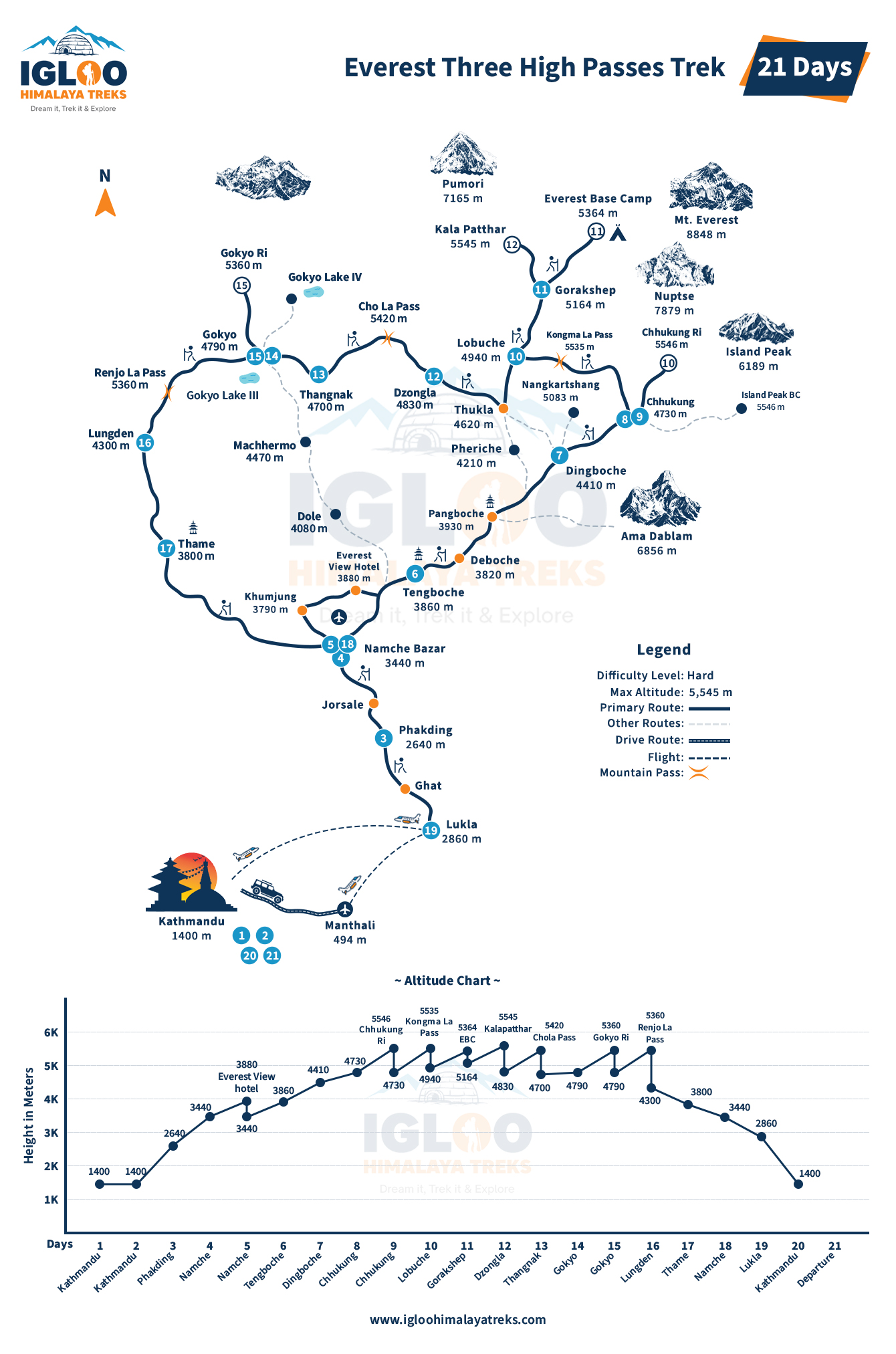
Kathmandu → Lukla → Phakding → Namche → Tengboche → Dingboche → Chhukung → Kongma La → Lobuche → Everest Base Camp → Kala Patthar → Dzongla → Cho La → Thangnak → Gokyo → Gokyo Ri → Renjo La → Lungdhen → Thame → Namche → Lukla → Kathmandu
What Makes the Everest Three Passes Trek Special?
Most Everest trekkers follow the same route toward Base Camp and return through the same valley. The Three Passes Trek takes a different approach.
You cross Kongma La, Cho La, and Renjo La, connect the Khumbu’s major valleys, reach Everest Base Camp, see the Gokyo Lakes, climb Gokyo Ri, and return through the historic Sherpa settlement of Thame.
The result is a much bigger picture of the Everest region.
You get the famous sights, but you also reach places that most standard Everest Base Camp trekkers never see. The route is harder, longer, and more demanding—but that is exactly what makes it special.
Everest Three High Passes Trek Highlights
- Cross Kongma La, Cho La, and Renjo La, the three major high passes of the Khumbu.
- Reach Everest Base Camp at 5,364 m.
- Climb Kala Patthar for one of the classic close-up views of Mount Everest.
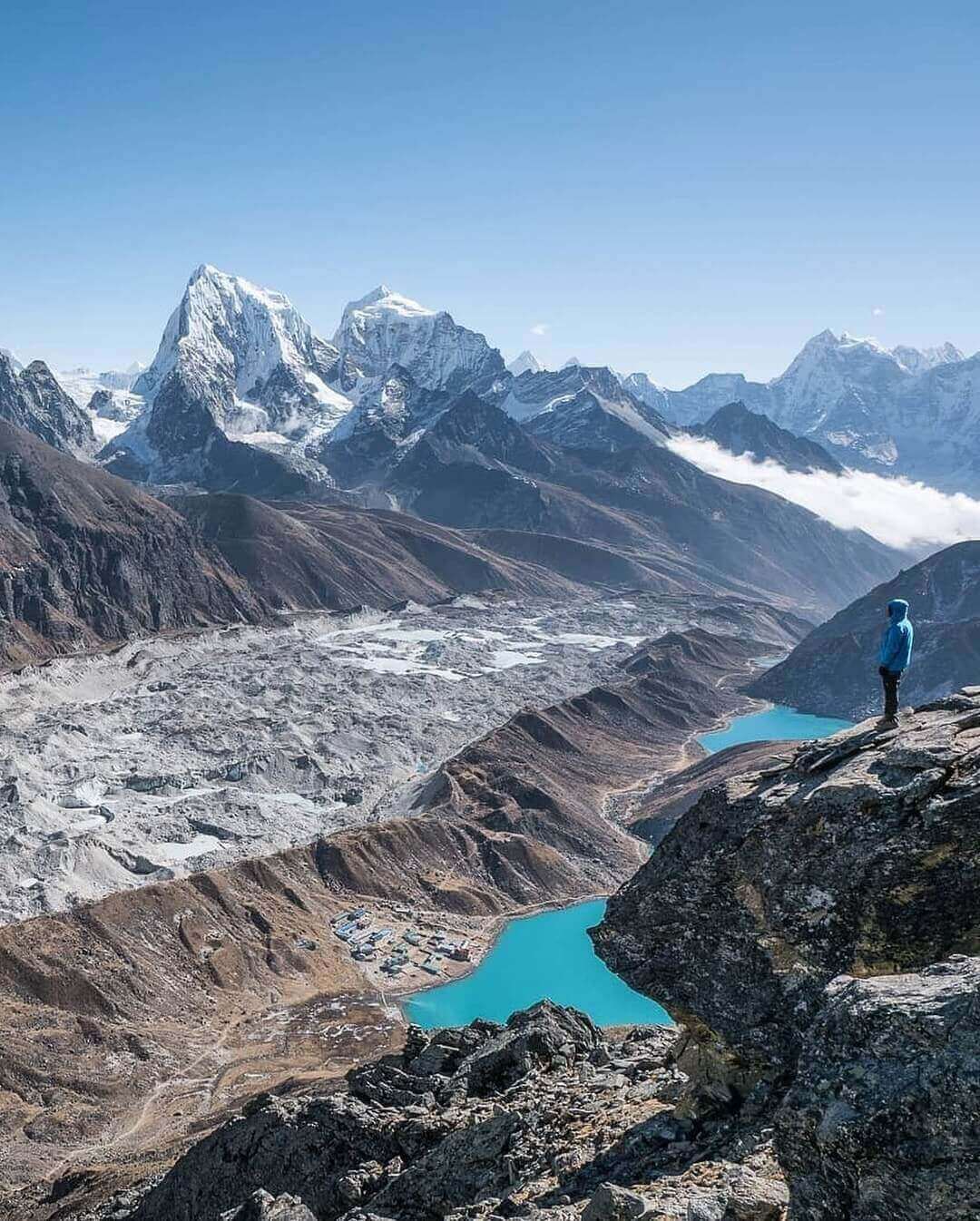
- See the turquoise Gokyo Lakes beneath the surrounding Himalayan peaks.
- Climb Gokyo Ri for a wide panorama of Everest, Lhotse, Makalu, Cho Oyu, and the Ngozumpa Glacier.
- Walk through the quieter Gokyo and Thame valleys, away from the busiest sections of the EBC trail.
- Explore Namche Bazaar, Tengboche, Dingboche, Chhukung, and traditional Sherpa settlements.
- Cross glacial and rocky terrain around Kongma La and Cho La, where conditions can change quickly.
- Follow the ancient trading-route landscape around Thame, a historic Sherpa village.
- Experience the full Khumbu circuit rather than simply walking to Everest Base Camp and returning the same way.
Everest Three High Passes Trek Itinerary
| Day | Route | Altitude | Walking / Travel |
| 1 | Arrival in Kathmandu | 1,400 m | Airport transfer |
| 2 | Kathmandu sightseeing & trek preparation | 1,400 m | Sightseeing |
| 3 | Fly to Lukla → Phakding | 2,652 m | 3 hr |
| 4 | Phakding → Namche Bazaar | 3,440 m | 6–7 hr |
| 5 | Namche acclimatization → Everest View Hotel | 3,880 m | 3–4 hr |
| 6 | Namche → Tengboche | 3,860 m | 5 hr |
| 7 | Tengboche → Dingboche | 4,410 m | 5 hr |
| 8 | Dingboche → Chhukung | 4,700 m | 2 hr |
| 9 | Chhukung Ri hike | 5,540 m | Day hike |
| 10 | Chhukung → Kongma La → Lobuche | 5,335 m | 7–8 hr |
| 11 | Lobuche → Everest Base Camp → Gorak Shep | 5,364 m | 8 hr |
| 12 | Kala Patthar → Dzongla | 5,545 m | 7 hr |
| 13 | Dzongla → Cho La → Thangnak | 5,420 m | 7 hr |
| 14 | Thangnak → Gokyo Lakes | 4,790 m | 2–3 hr |
| 15 | Gokyo Ri → Gokyo | 5,483 m | 3–4 hr |
| 16 | Gokyo → Renjo La → Lungdhen | 5,340 m | 7 hr |
| 17 | Lungdhen → Thame | 3,800 m | 4 hr |
| 18 | Thame → Namche Bazaar | 3,440 m | 4 hr |
| 19 | Namche → Lukla | 2,800 m | 7 hr |
| 20 | Fly Lukla → Kathmandu | 1,400 m | Flight |
| 21 | Final Departure | — | Airport transfer |
Welcome to Nepal.
After arriving at Tribhuvan International Airport, our representative will meet you and transfer you to your hotel in Kathmandu.
Once you have checked in, you can rest after your journey or take a short walk around Thamel, Kathmandu's well-known tourist district.
Later, you will meet your trekking guide for a briefing.
Your guide will explain the route, check your trekking equipment, and answer any final questions before the journey begins.
Altitude: 1,400 m
Accommodation: 3-star hotel
Meals: Breakfast
Today is a combination of trek preparation and cultural exploration in Kathmandu Valley.
After breakfast, you will visit some of the most famous UNESCO World Heritage Sites in the valley. These ancient landmarks reflect the deep religious traditions and artistic history of Nepal.
You may visit:
Swayambhunath (Monkey Temple) – A beautiful hilltop stupa with panoramic views of Kathmandu.
Boudhanath Stupa – One of the largest Buddhist stupas in the world, surrounded by monasteries and prayer wheels.
Pashupatinath Temple – A sacred Hindu temple complex located along the Bagmati River.
Kathmandu Durbar Square – A historic royal palace area filled with temples and traditional architecture.
After sightseeing, you will return to the hotel for final trek preparation. Your guide will check your trekking gear and make sure everything is ready for the journey to the Everest region.
Altitude: 1,400 m
Accommodation: 3-star hotel
Meals: Breakfast
The mountain journey begins with a flight to Lukla, the main gateway to the Everest region.
After landing, meet your trekking crew and begin walking through the lower Khumbu.
The trail passes through small Sherpa settlements, farmland, pine forests, and along sections of the Dudh Koshi River. The first day is deliberately short, giving you time to settle into the rhythm of trekking.
After around three hours, reach Phakding and settle into your mountain lodge.
Altitude: Phakding 2,652 m
Walking: Around 3 hours
Accommodation: Mountain lodge
Meals: Breakfast, Lunch, Dinner
Today you begin the longer climb toward Namche Bazaar.
The trail follows the Dudh Koshi, crossing several suspension bridges before entering Sagarmatha National Park. The route then climbs through pine and rhododendron forests toward the famous Hillary Suspension Bridge.
Beyond the bridge, the trail becomes noticeably steeper.
The final climb brings you into Namche Bazaar, the main commercial and cultural centre of the Khumbu.
After checking into your lodge, you can explore the town or simply rest after the day's climb.
Altitude: 3,440 m
Walking: 6–7 hours
Accommodation: Mountain lodge
Meals: Breakfast, Lunch, Dinner
Today is an important acclimatization day.
Instead of spending the entire day inside the lodge, take a gradual hike toward Everest View Hotel at around 3,880 metres.
From the viewpoint, you can see Mount Everest, Lhotse, Nuptse, Ama Dablam, and Thamserku on a clear day.
After returning to Namche, you can explore the town's cafés, bakeries, shops, and the Sherpa Culture Museum.
The extra day here gives your body more time to adjust before the route climbs deeper into the Khumbu.
Altitude: Namche 3,440 m | Everest View Hotel 3,880 m
Walking: 3–4 hours
Accommodation: Mountain lodge
Meals: Breakfast, Lunch, Dinner
Leave Namche and follow the hillside trail overlooking the Dudh Koshi Valley.
The route has a mixture of gradual climbs and descents, with impressive views of Everest, Ama Dablam, Lhotse, and Thamserku.
The trail then descends toward the river before climbing again through rhododendron and pine forest.
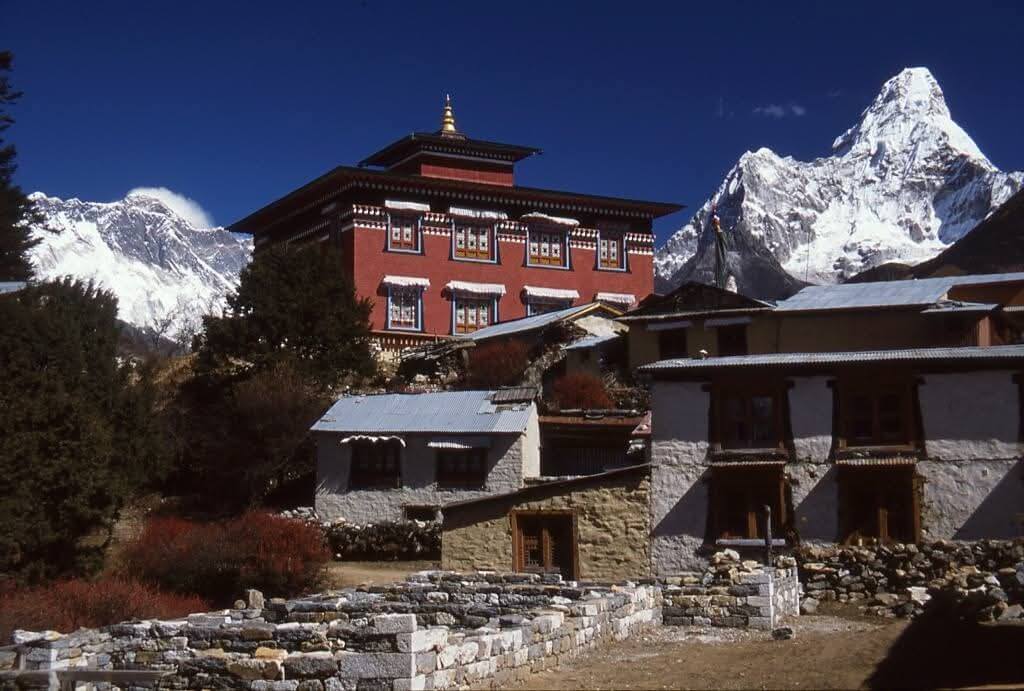
By afternoon, you reach Tengboche, home to the famous Tengboche Monastery.
Take some time to visit the monastery and enjoy the mountain panorama before settling into your lodge.
Altitude: 3,860 m
Walking: Around 5 hours
Accommodation: Mountain lodge
Meals: Breakfast, Lunch, Dinner
The trail continues toward the upper Imja Valley.
As you gain altitude, the dense forest gradually gives way to more open mountain terrain. You pass through Pangboche and continue toward Dingboche, with increasingly clear views of Ama Dablam, Lhotse, and Island Peak.
Dingboche is surrounded by stone walls that protect fields from the strong mountain winds.
At 4,410 metres, this is an important point in the gradual climb toward the high passes.
Altitude: 4,410 m
Walking: Around 5 hours
Accommodation: Mountain lodge
Meals: Breakfast, Lunch, Dinner
Today is intentionally short.
Follow the Imja Valley toward Chhukung, a small settlement surrounded by some of the Khumbu's most impressive peaks.
The views toward Lhotse, Ama Dablam, and Island Peak become increasingly prominent as the valley opens up.
After reaching Chhukung, you have the rest of the afternoon to rest and prepare for tomorrow's high-altitude hike to Chhukung Ri.
Altitude: 4,700 m
Walking: Around 2 hours
Accommodation: Mountain lodge
Meals: Breakfast, Lunch, Dinner
Today is an important acclimatization and viewpoint day.
The trail climbs steadily above Chhukung toward Chhukung Ri, with the terrain becoming increasingly rocky as you gain elevation.
From the high point, the surrounding panorama opens toward Lhotse, Makalu, Ama Dablam, Island Peak, and the surrounding glaciers.
After spending some time at the viewpoint, descend back to Chhukung.
This hike also prepares you mentally and physically for the first major pass crossing tomorrow.
Altitude: Approximately 5,540 m
Walking: Day hike
Accommodation: Mountain lodge
Meals: Breakfast, Lunch, Dinner
Today you cross your first high pass: Kongma La.
This is one of the toughest days of the trek. The trail climbs over rocky terrain and glacial moraine before reaching the pass at around 5,335 metres.
The final climb can be demanding, particularly if snow covers the trail.
At the top, prayer flags mark Kongma La and the surrounding mountains stretch across the horizon.
After crossing the pass, descend toward the Khumbu Glacier and continue to Lobuche.
It is a long day, but completing the first pass marks a major milestone in the Three High Passes journey.
Altitude: Kongma La 5,335 m | Lobuche 4,910 m
Walking: 7–8 hours
Accommodation: Mountain lodge
Meals: Breakfast, Lunch, Dinner
Today you finally reach Everest Base Camp.
Start from Lobuche and follow the high-altitude trail toward Gorak Shep. After a short break, continue toward Base Camp along the rugged moraine landscape beside the Khumbu Glacier.
The route is demanding at this elevation, so your guide will maintain a steady pace.
At Everest Base Camp, take time to enjoy the achievement and surrounding mountain landscape. You can see the Khumbu Glacier, surrounding peaks, and the famous route used by Everest expeditions.
After spending time at Base Camp, retrace the trail to Gorak Shep for the night.
Altitude: Everest Base Camp 5,364 m | Gorak Shep approximately 5,180 m
Walking: Around 8 hours
Accommodation: Mountain lodge
Meals: Breakfast, Lunch, Dinner
Start early for the climb to Kala Patthar.
The trail rises above Gorak Shep, and as the sun comes up, the mountains gradually light up around you.
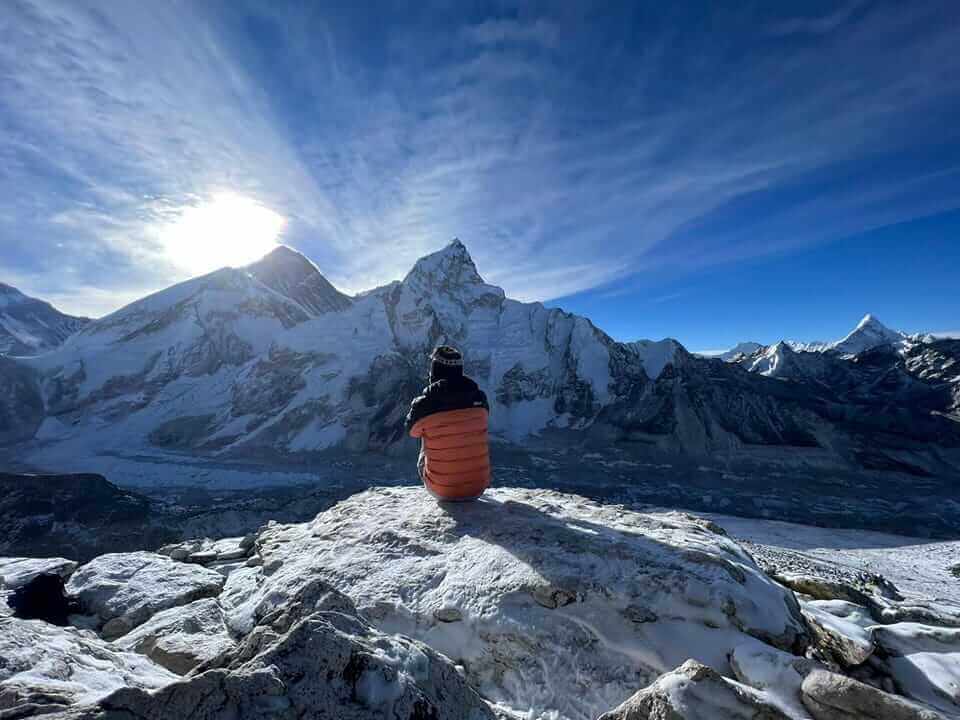
From Kala Patthar, you get one of the classic close views of Mount Everest, Nuptse, Pumori, and the surrounding Himalayan peaks.
After descending to Gorak Shep for breakfast, continue toward Dzongla.
The route now leaves the main EBC trail and heads toward the quieter landscape below Cho La.
Altitude: Kala Patthar 5,545 m | Dzongla 4,830 m
Walking: Around 7 hours
Accommodation: Mountain lodge
Meals: Breakfast, Lunch, Dinner
Today you cross the second high pass: Cho La.
The climb begins from Dzongla and becomes steeper as you approach the pass. The upper section can contain snow and ice, particularly outside the main trekking seasons, so careful footing is essential.
At approximately 5,420 metres, Cho La connects the Everest Base Camp side of the Khumbu with the Gokyo Valley.
After crossing the pass, descend toward Thangnak, a small settlement beneath the high mountains.
Altitude: Cho La 5,420 m | Thangnak 4,700 m
Walking: Around 7 hours
Accommodation: Mountain lodge
Meals: Breakfast, Lunch, Dinner
After yesterday's demanding pass crossing, today is shorter and gives you time to enjoy the Gokyo Valley.
The trail follows the edge of the Ngozumpa Glacier, one of the largest glacier systems in the region.
Soon the famous Gokyo Lakes begin to appear.
Their turquoise colour stands out against the surrounding rocky and snow-covered mountains. Gokyo village sits beside the lakes and offers one of the most peaceful overnight stops of the entire trek.
Altitude: Gokyo 4,790 m
Walking: 2–3 hours
Accommodation: Mountain lodge
Meals: Breakfast, Lunch, Dinner
Today you climb Gokyo Ri, one of the finest viewpoints in the Everest region.
The climb is steep, but the panorama from the top makes the effort worthwhile.
From Gokyo Ri, you can see Everest, Lhotse, Makalu, Cho Oyu, the Ngozumpa Glacier, and the Gokyo Lakes spread across the landscape.
After enjoying the view, descend back to Gokyo for a well-earned rest.
Altitude: Gokyo Ri approximately 5,483 m
Walking: 3–4 hours
Accommodation: Mountain lodge
Meals: Breakfast, Lunch, Dinner
Today you cross the third and final high pass: Renjo La.
The trail climbs steadily above the Gokyo Valley toward the pass.
From the top, the view stretches across the Gokyo Lakes, Everest, Lhotse, Makalu, and the surrounding high mountains.
After crossing Renjo La, descend into the quieter valley toward Lungdhen.
You have now crossed all three major passes of the route—Kongma La, Cho La, and Renjo La.
Altitude: Renjo La 5,340 m | Lungdhen 4,300 m
Walking: Around 7 hours
Accommodation: Mountain lodge
Meals: Breakfast, Lunch, Dinner
The trail now descends into a lower and greener section of the Khumbu.
You follow an old Himalayan trading-route landscape toward Thame, one of the historic Sherpa settlements in the region.
Thame is known for its traditional Sherpa culture and monastery and is also associated with several famous Everest mountaineers.
After days above 5,000 metres, the lower elevation and quieter valley make today a welcome change.
Altitude: 3,800 m
Walking: Around 4 hours
Accommodation: Mountain lodge
Meals: Breakfast, Lunch, Dinner
Continue along the valley toward Namche Bazaar.
The trail passes through forest and smaller settlements before reconnecting with the main Khumbu route.
Once back in Namche, you can enjoy some of the comforts of the town—hot showers, cafés, bakeries, shops, and a proper rest after completing all three high passes.
This is also a good evening to celebrate the achievement with your trekking team.
Altitude: 3,440 m
Walking: Around 4 hours
Accommodation: Mountain lodge
Meals: Breakfast, Lunch, Dinner
Your final trekking day takes you back toward Lukla.
The trail descends through forests and follows the Dudh Koshi Valley, crossing suspension bridges and passing the villages you encountered at the beginning of the trek.
After several weeks in the high mountains, reaching Lukla feels different. The trail that once marked the beginning of your adventure now becomes the final walking section.
Enjoy your final evening with the trekking team before tomorrow's flight.
Altitude: 2,800 m
Walking: Around 7 hours
Accommodation: Mountain lodge
Meals: Breakfast, Lunch, Dinner
After breakfast, take your flight from Lukla to Kathmandu.
The flight offers one final aerial view of the Himalayan landscape before returning to the capital.
After reaching Kathmandu, transfer to your hotel and take the rest of the day to rest.
You have now completed the full Everest Three High Passes circuit.
Altitude: Kathmandu 1,400 m
Accommodation: 3-star hotel
Meals: Breakfast
Today marks the end of your Everest Three High Passes Trek.
After breakfast, our representative will transfer you to the airport according to your flight schedule.
Before you leave, you will receive your trek completion certificate and an Igloo Himalaya Treks souvenir to mark the achievement.
You leave Nepal with memories of Kongma La, Cho La, Renjo La, Everest Base Camp, Kala Patthar, Gokyo Lakes, Gokyo Ri, Thame, Sherpa villages, glaciers, and the high mountains of the Khumbu but also of the guides who walked beside you, the warm mountain lodges where you rested, the meals shared after long days, and the care of the Igloo Himalaya Treks team that helped make the journey possible.
Meals: Breakfast
Cost Includes
- Airport Transfers
- Private vehicle transfers for both arrival and departure in Kathmandu for a smooth and comfortable start and end to your journey.
- Kathmandu Hotel Accommodation
- Three nights’ stay in a comfortable 3-star hotel in Kathmandu on a BB (Bed & Breakfast) plan.
- Full-Board Meals During the Trek
- Daily breakfast, lunch, and dinner throughout the trek, including a serving of seasonal fruit and a Snickers chocolate after dinner for extra energy.
- Professional English-Speaking Trekking Guide and Porter
- An experienced and knowledgeable trekking guide from Igloo Himalaya Treks who speaks fluent English and ensures a safe and enjoyable trekking experience. One porter for two people to carry your baggage.
- Guide Expenses Covered
- All guide-related costs including salary, insurance, meals, accommodation, and required trekking equipment.
- Round-Trip Lukla Flights
- Domestic flights between Kathmandu (or Manthali) and Lukla for quick and scenic access to the Everest region.
- Kathmandu – Manthali Road Transportation
- Comfortable road transportation between Kathmandu and Manthali when Lukla flights operate from Manthali Airport.
- Trekking Gear Provided
- Complimentary trekking gear including a duffel bag, sleeping bag, and down jacket (to be returned after the trek).
- Igloo Himalaya Treks Souvenir
- A company-branded T-shirt as a memorable keepsake of your Himalayan adventure.
- First-Aid Support on the Trek
- Your guide carries a well-equipped first-aid kit to ensure safety and assistance throughout the trail.
- Trek Completion Certificate
- A special certificate from Igloo Himalaya Treks to celebrate your successful trek in the Himalayas.
- Trekking Permits Included
- All required permits for the Everest region including:
- Sagarmatha National Park Entry Permit
- Khumbu Pasang Lhamu Rural Municipality Entry Permit
- Emergency Evacuation Coordination
- Emergency helicopter evacuation services will be arranged if required (costs covered by the trekker or their travel insurance).
- Government Taxes and Service Charges
- All applicable government taxes and official service charges included in the package.
Cost Excludes
- Travel Insurance: We strongly recommend that all trekkers obtain travel insurance that covers high-altitude trekking and emergency rescue or evacuation operations.
- Personal Expenses During the Trek: Any personal spending during the trek, such as hot showers, device charging, and internet or Wi-Fi access at teahouses.
- Beverages: All drinks, including tea, coffee, mineral water, soft drinks, and alcoholic beverages, are not included in the package cost.
- Extra Baggage Charges: Domestic flights to Lukla allow a baggage limit of 15 kg per person (including hand luggage). Any excess baggage will incur additional airline charges.
- Personal Trekking Equipment: Trekkers are responsible for bringing or renting their own trekking gear and personal equipment.
- Tips and Gratuities: Tips for guides, porters, and other support staff are not included and are entirely at the discretion of the trekkers.
- Unforeseen Expenses: Any additional costs caused by unexpected situations such as flight delays, weather conditions, natural events, or personal emergencies are not covered in the package
Map
Accommodation During the Trek
Accommodation is provided in teahouses and mountain lodges throughout the trekking route, with a three-star hotel in Kathmandu.
Mountain accommodation is simple but designed around the needs of trekkers. Rooms are generally twin-sharing, while bathrooms may be shared, particularly at higher elevations.
At places such as Gokyo, Lungdhen, Dzongla, Gorak Shep, and Lobuche, facilities are naturally more basic because these settlements are remote and lie at high altitude.
Your accommodation is arranged in advance by Igloo Himalaya Treks, so you can reach each destination, check in, put down your bags, and focus on resting.
If you want to know where you will stay on each night and what facilities are available, consult Igloo Himalaya Treks before your trek.
Food and Meals
The package includes breakfast, lunch, and dinner throughout the trekking section, along with seasonal fruit and a Snickers chocolate after dinner.
Meals become simpler as you move higher into the Khumbu, but teahouses generally offer filling dishes such as:
- Dal bhat
- Sherpa stew
- Thukpa
- Momo
- Noodles
- Pasta
- Rice and curry
- Potatoes
- Eggs
- Pancakes
- Soup
- Seasonal vegetables
If you have a specific dietary requirement or food preference, consult with Igloo Himalaya Treks before the trek so we can discuss what can be arranged.
How Difficult Is the Everest Three High Passes Trek?
The Everest Three Passes Trek is a very challenging high-altitude trek and is best suited to trekkers with previous trekking experience and strong physical preparation.
The route crosses:
- Kongma La – approximately 5,535 m
- Cho La – approximately 5,420 m
- Renjo La – approximately 5,340 m
It also reaches Everest Base Camp, Kala Patthar, and Gokyo Ri, all above 5,000 metres.
Some pass crossings involve steep rocky terrain, glacial sections, snow or ice depending on conditions, and long days at altitude. This is not a technical mountaineering expedition, but it is significantly harder than the standard Everest Base Camp trek.
That is where having an experienced guide and professional trekking team makes a real difference. From choosing the right pace and monitoring your condition to handling the route, accommodation, meals, and day-to-day logistics, our team is there to make the journey easier and more manageable.
The mountains will still challenge you, but you do not have to face those challenges alone. That is exactly why travelling with an experienced trekking agency and guide matters on a trek like this. OUR TEAMS
Altitude and Acclimatization
Altitude is one of the biggest challenges of the Three Passes route.
The itinerary gradually climbs through Namche, Tengboche, Dingboche, Chhukung, and the higher valleys before reaching the passes.
The acclimatization day in Namche is particularly important. The Chhukung Ri hike also gives you time at high altitude before crossing Kongma La.
Your guide will monitor your condition throughout the trek. If you experience serious altitude symptoms, you gotta inform your guide immediately.
Do not continue upward simply because the itinerary says so. Your health takes priority.
NOTE: Your health is always more important than completing the itinerary on a particular day. If you need more time to rest, slow down, or adjust the plan because of altitude, our team will work with you to make the safest possible decision. The schedule can be changed; your health cannot be compromised.
Best Time for Everest Three High Passes Trek
The best seasons for the Everest Three High Passes Trek are spring and autumn, when the weather is generally more suitable for high-pass crossings.
Spring: March to May
March can still be cold at high elevations, while April and May generally offer warmer conditions and clearer mountain views.
Rhododendrons are also in bloom at lower elevations during spring.
Autumn: September to November
Autumn is one of the most popular periods for the Everest region.
After the monsoon, the air is often clearer, visibility is better, and conditions are generally more stable for crossing the high passes.
October and November are particularly popular for high-altitude trekking.
Winter: December to February
Winter brings much colder conditions and greater chances of snow and ice on the passes.
The Three High Passes route becomes significantly more demanding during this period and is not the preferred season for this itinerary.
Monsoon: June to August
Monsoon brings rain, cloud, wet trails, and potentially more difficult flight conditions.
Because this route depends heavily on safe conditions at three passes above 5,000 metres, the monsoon season is generally not recommended.
What Should You Pack?
This is a high-altitude trek, so proper equipment is essential.
Essential Gear
- Waterproof trekking boots
- Thermal base layers
- Fleece jacket
- Down jacket
- Waterproof jacket and trousers
- Warm trekking trousers
- Gloves
- Warm hat
- Sun hat
- Sunglasses
- Trekking poles
- Headlamp
- Water bottles or hydration system
- Sunscreen
- Lip balm
- Personal medication
- Small daypack
- Toiletries
- Power bank
Igloo Himalaya Treks provides a duffel bag, sleeping bag, and down jacket for use during the trek.
If you are unsure about any equipment, consult with Igloo Himalaya Treks before departure.
Safety and Emergency Support
Crossing three high passes requires careful planning and an experienced trekking team.
Your guide will monitor the group’s pace and condition throughout the route. A first-aid kit is also carried during the trek.
The itinerary includes acclimatization before the major pass crossings, but altitude sickness remains a genuine risk.
Travel insurance covering high-altitude trekking and emergency evacuation is strongly recommended.
If emergency evacuation becomes necessary, our team can assist with coordinating the evacuation. The cost of evacuation is the responsibility of the trekker or their travel insurance, according to the policy terms.
Why Trek with Igloo Himalaya Treks?
The Three High Passes route requires more than simply following a map. Conditions at high altitude can change quickly, and good pacing and route management matter.
With Igloo Himalaya Treks, you travel with an experienced local guide, porter support, pre-arranged accommodation, organized permits, domestic flights, trekking equipment, and emergency coordination.
Our team handles the practical details while you focus on the mountains, the trail, and completing all three passes.
Why Not Trek the Everest Three High Passes Independently?
Trekking Alone May Sound Simple, But It Is Different in Practice
On a map, the Three Passes Trek can look simple: walk to the next village, follow the trail, cross the pass, and continue. In reality, being in an unfamiliar part of the Himalayas makes every decision more important.
You need to know which trail to follow, where to stay, how long each section should take, when it is safe to cross a pass, and when your body needs more rest. A wrong turn can cost hours, while a sudden weather change can make a pass unsafe to cross.
Altitude adds another layer. If someone develops a headache, nausea, unusual tiredness, or other symptoms, you need to recognize what is happening and know whether to rest, continue, or descend. At 5,000 metres, simply pushing ahead because the itinerary says so is not always the right decision.
This is where an experienced local team makes a real difference. Our guides know the trail, understand the conditions, manage the pace, and can adjust the plan when necessary. They also take care of accommodation, permits, logistics, and other practical details along the way.
You can trek independently, but on a route this demanding, having someone experienced beside you means fewer things to worry about and better support when something does not go as planned. With Igloo Himalaya Treks, you can focus on walking, enjoying the mountains, and completing the journey while our team takes care of the details.
Is the Everest Three Passes Trek Worth It?
Yes. Yes, and absolutely yes.
If you are looking for a trek that gives you more than just reaching Everest Base Camp, the Everest Three High Passes Trek is absolutely worth it.
You get a little bit of everything that makes trekking in Nepal so special. High mountain passes, changing landscapes, quiet valleys, Sherpa villages, glaciers, turquoise Gokyo Lakes, dramatic mountain views, and some seriously demanding days on the trail. One day you may be walking through a busy mountain village, and the next you are standing above 5,000 metres surrounded by nothing but mountains and open Himalayan terrain.
And yes, it is difficult. But that difficulty is part of the adventure. Crossing Kongma La, Cho La, and Renjo La gives the trek a completely different feeling from simply walking to Everest Base Camp and returning the same way. You have to work for those views, and that makes reaching each pass feel even better.
Nepal has many incredible trekking routes, from the Annapurna Circuit and Manaslu to Langtang and Everest Base Camp. The Three Passes Trek stands proudly among them because it gives you challenge, variety, remote trails, and some of the best mountain scenery in the country in one long journey.
Some days will be tiring. Some climbs will make you question yourself. Then you reach the top, look around, and realize exactly why you came.
It is demanding, adventurous, and incredibly rewarding. You don’t simply visit the Everest region you experience it from every side.
Recommended Treks
Everest Base Camp Trek
The classic route to Everest Base Camp for trekkers who want the iconic Khumbu journey without the three high passes.
Everest Base Camp Trek – 14 Days
Everest Base Camp Luxury Trek
A more comfortable Everest experience with five-star accommodation in Kathmandu and premium mountain lodging at selected stops.
Gokyo Lakes Trek
A shorter way to experience the Gokyo Valley, turquoise lakes, and high Himalayan viewpoints.
Everest Cho La and Renjo La Pass Trek
A shorter high-pass option combining Everest Base Camp country with two major passes and the Gokyo Valley.