
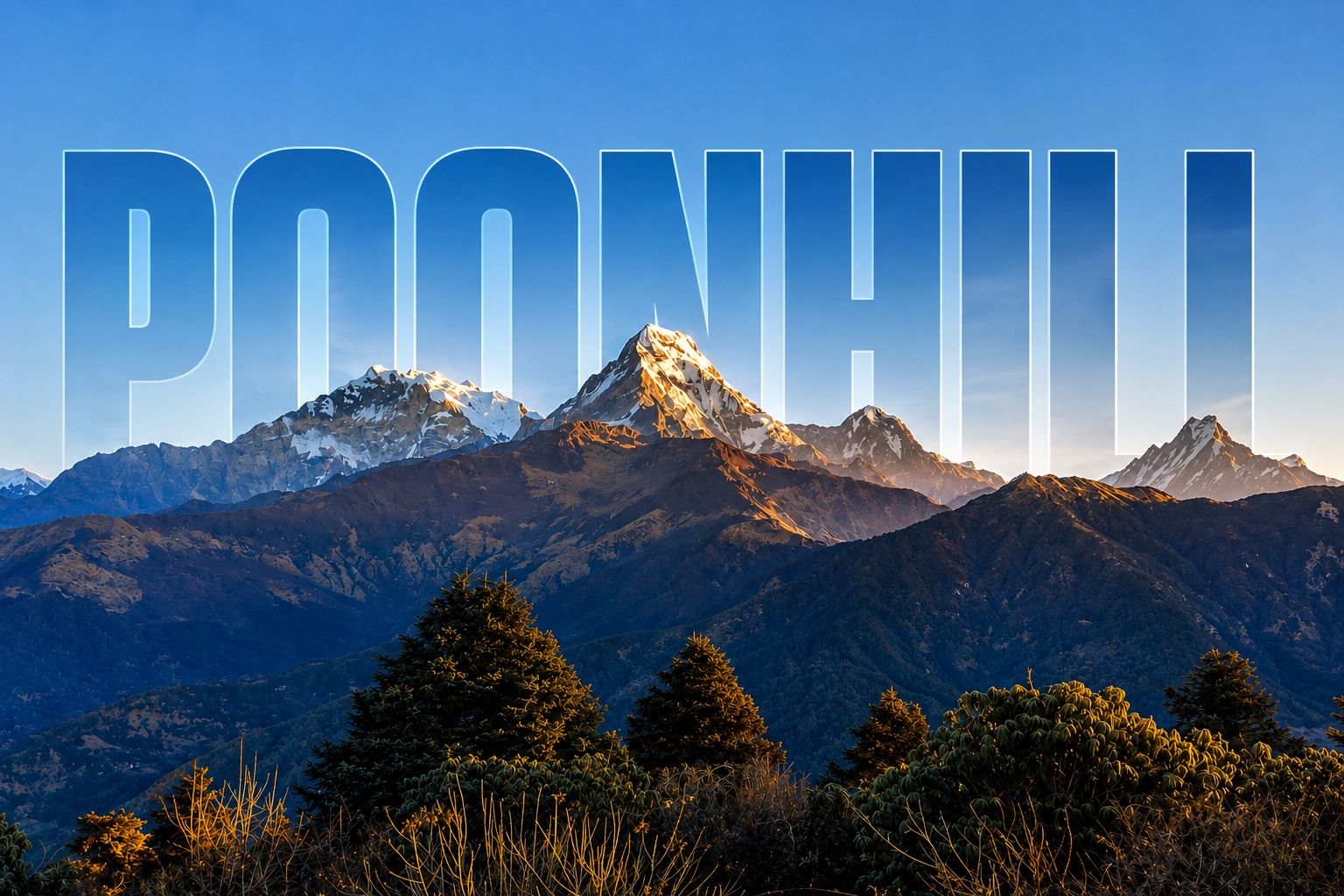
Poon Hill Trek
The Poon Hill Trek is a short trek in Nepal’s Annapurna region that climbs to a 3,210 m viewpoint above the village of Ghorepani, best known for its sunrise panorama of the Annapurna and Dhaulagiri ranges. It typically takes 4 to 5 days round trip from Pokhara and requires no prior trekking experience, which is why it’s one of the most-booked short treks in the country.
This guide covers exactly where Poon Hill is, how the trek is structured day by day, what permits it requires, what you’ll actually see from the top, and whether it fits your fitness level and time frame.
Where Is Poon Hill Located?
Poon Hill sits in the Annapurna region of central Nepal, inside the Annapurna Conservation Area, roughly northwest of Pokhara.
It rises above the village of Ghorepani, in the Myagdi district on the border with Kaski district, and is reached by trekking from the trailhead town of Nayapul, itself about 1 to 1.5 hours by road from Pokhara.
Pokhara is the gateway city for the entire trip: most itineraries start with a drive or short flight from Kathmandu to Pokhara before the actual trekking begins.
Quick facts
| Information | Details |
| Location | Annapurna region, central Nepal |
| Province | Gandaki Province |
| District | On the border of Myagdi and Kaski districts |
| Protected area | Annapurna Conservation Area |
| Nearest village | Ghorepani |
| Nearest gateway city | Pokhara |
| Approximate distance from Pokhara | Around 50 km northwest |
| Latitude | Approximately 28.4000° N |
| Longitude | Approximately 83.6895° E |
| Elevation | Approximately 3,210 metres (10,531 feet) |
| Popular trek name | Ghorepani–Poon Hill Trek |
| Common trailhead | Nayapul or Birethanti |
How High Is Poon Hill?
Poon Hill’s summit sits at 3,210 m (10,531 ft) above sea level. That makes it high enough for genuinely alpine views but well below the altitude where acute mountain sickness becomes a serious concern, since most guidelines flag risk starting above 3,500 m.
The trek’s other stops sit lower still: Ghorepani, the overnight base for the Poon Hill sunrise hike, is at about 2,860 m (9,380 ft), and the trailhead at Nayapul starts around 1,070 m (3,510 ft).
Why Is Poon Hill Trek Popular?
Poon Hill draws more visitors than almost any other short trek in Nepal for a specific combination of reasons:
It delivers a 360-degree Himalayan panorama, including four peaks above 8,000 m in view from a single point, in a trip that can be done in under a week without technical gear or prior altitude experience.
The trail passes through Gurung and Magar villages with a distinct cultural identity, runs through rhododendron forest that blooms bright red and pink each spring, and stays low enough in elevation that altitude sickness is a minor concern compared to treks like Everest Base Camp or the Annapurna Circuit.
It is also one of the few Himalayan treks realistically doable by families with children or trekkers in their 60s and 70s, which broadens who actually books it.
How Long Is the Poon Hill Trek?
Most standard itineraries run 4 to 5 days from Pokhara, covering roughly 37 to 45 km round trip depending on the exact route and whether you exit via Ghandruk or return the way you came.
Including travel time from Kathmandu at both ends, many operators package it as a 7- to 8-day trip overall.
Shorter 3-day versions exist for trekkers with limited time, strong fitness, or those who are already in Kathmandu or Pokhara, while some operators stretch the same route to 9 to 11 days by adding rest days, side trips, or extra villages.
Can Poon Hill Trek Be Completed in 3 Days?
Yes, but only with strong fitness and a tight schedule.
A 3-day version typically drives directly from Pokhara to Ulleri or even Ghorepani directly on day one to skip the lower walking sections, hikes to Poon Hill for sunrise and returns to Ghorepani on day two, then descends the full way back to Nayapul or Ghandruk on day three.
This compresses what is normally a more relaxed 4 to 5 day walk into a demanding, fast-paced itinerary doable for a fit trekker short on time, but it leaves little room to enjoy the villages along the way or recover if the weather or your body does not cooperate.

How Difficult Is the Poon Hill Trek?
Poon Hill is generally graded easy to moderate, the easiest classification given to any multi-day trek in the Annapurna region.
The main physical challenge is not altitude; it is the stone staircases, particularly the roughly 3,200-plus steps climbing into Ulleri, which are steep and relentless even for trekkers with reasonable fitness.
Daily walking typically runs 4 to 7 hours over well-maintained, clearly marked trails, with daily elevation gain generally staying under 900 m.
No technical skill, climbing gear, or prior high-altitude experience is required, though a reasonable baseline of cardiovascular fitness makes the stone-step sections considerably more comfortable.
Poon Hill Trek Itinerary
A typical 5-day itinerary from Pokhara looks like this:
- Pokhara to Tikhedhunga (1,540 m): Drive roughly 1 to 1.5 hours to Nayapul, then trek 4 to 5 hours along the Modi Khola river through Birethanti to Tikhedhunga.
- Tikhedhunga to Ghorepani (2,860 m): The trek is toughest day climb the stone staircase to Ulleri (2,050 m), then continue through oak and rhododendron forest to Ghorepani, roughly 6 to 7 hours total.
- Sunrise at Poon Hill, then to Tadapani (2,630 m): Pre-dawn hike (45 minutes to an hour) up to Poon Hill for sunrise, descend to Ghorepani for breakfast, then trek onward to Tadapani, around 5 to 6 hours combined.
- Tadapani to Ghandruk (1,940 m): A gentler descent of 3 to 4 hours into Ghandruk, one of the region’s largest Gurung villages, with time to visit its cultural museum.
- Ghandruk to Pokhara: Trek down to Syauli Bazaar or Nayapul (3 to 4 hours), then drive back to Pokhara.
Some itineraries reverse the exit route or skip Tadapani and Ghandruk entirely, returning the same way through Ulleri and Nayapul instead, a slightly shorter but less scenic option.
Note: We also offer an 8-day Poon Hill Trek itinerary, but we can also customize the trek based on your available time and preferences. Whether you have more or fewer days, we can adjust the route and daily walking hours to create an itinerary that works for you. You can always contact Igloo Himalayan Treks to discuss your preferred itinerary.
What Can You See From Poon Hill?
From Poon Hill, you can see some of the most famous peaks in the Annapurna and Dhaulagiri ranges. The main views include:
- Dhaulagiri – 8,167 m: One of the world’s highest mountains, Dhaulagiri dominates the western horizon with its massive snow-covered summit.
- Annapurna I – 8,091 m: The highest peak in the Annapurna range, rising dramatically above the surrounding Himalayan landscape.
- Annapurna South – 7,219 m: A striking, sharply shaped mountain located south of the main Annapurna massif.
- Annapurna II, III, and IV: A group of impressive Himalayan peaks that form an important part of the panoramic Annapurna skyline.
- Machhapuchhre, or “Fishtail” – 6,993 m: Recognized for its distinctive double summit, this sacred mountain is one of Nepal’s most famous and beautiful peaks.
- Nilgiri – 7,061 m: A prominent snow-covered mountain that adds to the dramatic scenery around the Kali Gandaki and Annapurna region.
- Hiunchuli – 6,441 m: A striking peak connected to the Annapurna massif and visible among the surrounding mountain range.
- Gangapurna: A beautiful Himalayan peak known for its snow-covered slopes and impressive presence near the Annapurna Sanctuary.
- Tukuche Peak: A spectacular mountain in the Dhaulagiri region, rising above the surrounding valleys and alpine landscapes.
- Lamjung Himal: A striking Himalayan range that contributes to the eastern panorama from Poon Hill.
Sunrise Mountain Views
The sunrise is the main attraction at Poon Hill. Trekkers usually begin the short ascent before dawn to reach the viewpoint in time for the first light.
As the sun rises, the snow-covered peaks of Dhaulagiri, Annapurna, Machhapuchhre, and the surrounding mountains gradually change from blue and grey to shades of gold and pink.
Best Time to Trek to Poon Hill
Poon Hill is a year-round trekking destination, but spring and autumn are the main seasons for the best overall experience.
These months offer a strong combination of clear Himalayan views, comfortable daytime temperatures, stable trail conditions, and better chances of seeing the sunrise from the viewpoint.
Spring is ideal for rhododendron flowers, while autumn usually provides the clearest mountain visibility after the monsoon.
-
Spring: March to May
Spring is the best season for trekkers who want to see Poon Hill’s forests in bloom.
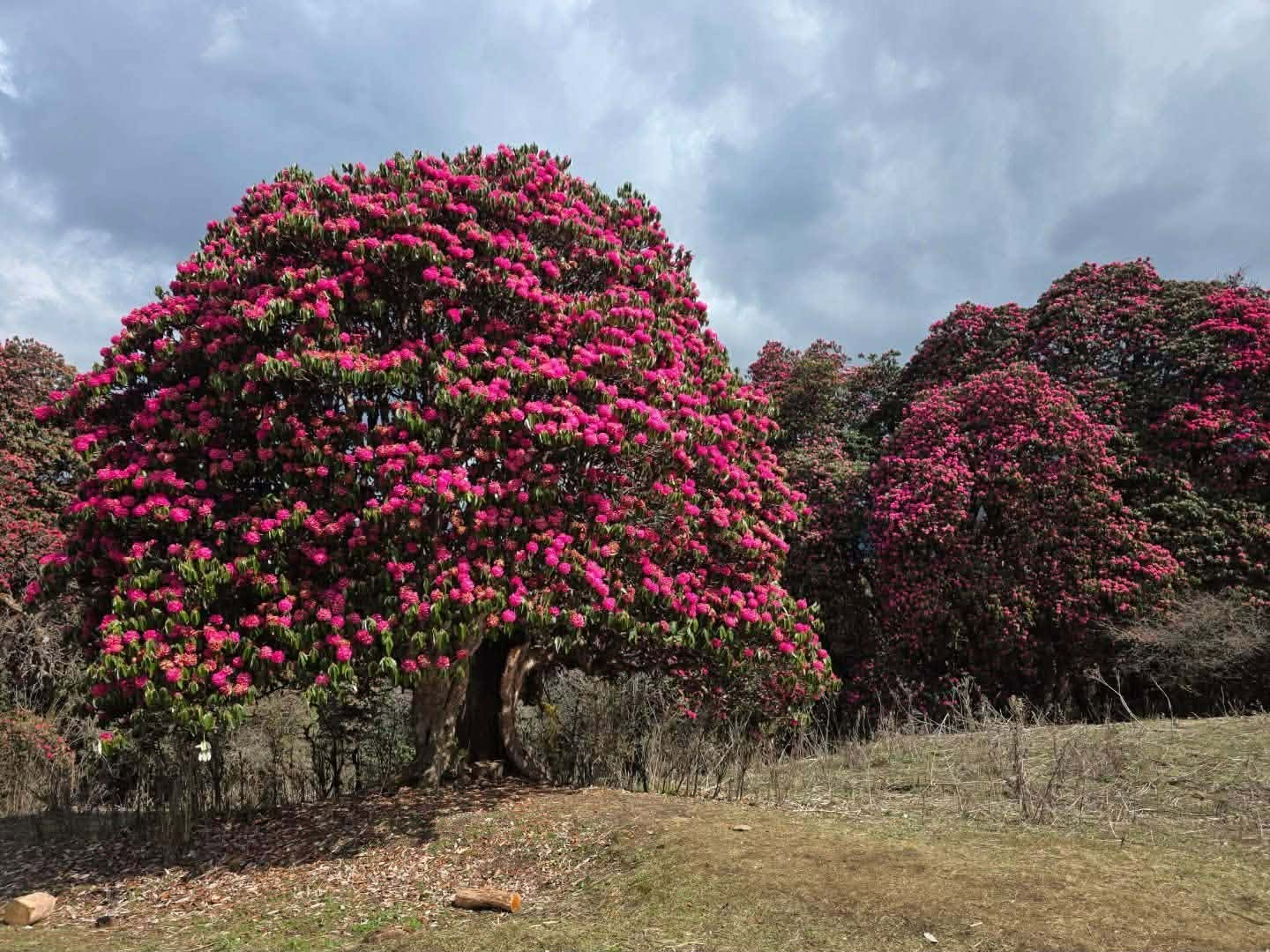
Rhododendrons usually begin flowering in March and reach their most colorful period around late March and April, especially along the Ulleri–Ghorepani section.
Days are generally mild, with temperatures around 10°C to 24°C in the Ghorepani area, while early mornings at Poon Hill can still feel close to freezing. May remains warm and pleasant, although some pre-monsoon haze may develop later in the month.
-
Summer and Monsoon: June to August
The monsoon transforms the Poon Hill route into a lush green landscape, with fresh vegetation, waterfalls, and fewer visitors on the trail.
This season is suitable for trekkers who enjoy peaceful paths and vibrant scenery. Rain can make some sections slippery, and clouds may occasionally cover the mountain panorama, but clear periods can still provide beautiful views between showers.
-
Autumn: September to November
Autumn is generally the most reliable season for the classic Poon Hill sunrise experience.
September marks the transition from the monsoon, while October and November usually bring cleaner skies, dry trails, and excellent visibility of Dhaulagiri, Annapurna, and Machhapuchhre.
Daytime temperatures around Ghorepani are commonly comfortable for walking, although mornings and nights become colder as November progresses.
-
Winter: December to February
Winter offers quiet trails, crisp air, and excellent visibility on many mornings.
The route is less crowded, and the surrounding peaks often appear especially sharp against the clear sky.
Temperatures drop significantly before sunrise, and light snowfall is possible around Ghorepani and Poon Hill, so warm clothing, gloves, and a proper sleeping bag are important.
Tea houses generally remain available during the winter season.
Recommended Months
For the best balance of clear views, comfortable walking weather, and reliable sunrise conditions, choose October to November or March to April.
Visit in spring for blooming rhododendrons, or choose autumn for the clearest skies and sharpest Himalayan panoramas.
How to Trek to Poon Hill Alone?
Since April 2023, Nepal requires all foreign trekkers on Annapurna Conservation Area routes, including Poon Hill, to be accompanied by a licensed guide hired through a government-registered trekking agency.
Independent, guideless trekking is no longer a legal option here, regardless of experience level.
That said, “alone” in the sense of not joining a group tour is still entirely possible: you can book a private guide through an agency, travel at your own pace, choose your own overnight stops, and never join a fixed departure group.
Solo travelers routinely do Poon Hill this way, with just a guide and, optionally, a porter for their own bag.
What to Bring for the Poon Hill Trek?
The Poon Hill Trek does not require heavy expedition equipment, but the route includes long stone staircases, cool pre-dawn walks, and changing mountain weather.
Pack light and focus on comfortable footwear, warm layers, rain protection, and a few practical trail essentials.
Footwear and Trail Gear
- Hiking boots: Bring comfortable, broken-in boots with good ankle support and a strong grip. The steep stone steps around Ulleri and Ghorepani can be tiring, especially during wet weather.
- Trekking poles: Poles provide useful support on uphill staircases and help reduce pressure on the knees during long descents.
- Trekking socks: Carry three or four pairs of wool or moisture-wicking socks to keep your feet dry and reduce the risk of blisters.
- Lightweight daypack: A 20–30 litre daypack is suitable for carrying water, snacks, a jacket, sunscreen, and personal items. If you are carrying all your luggage yourself, use a larger 30–40 litre backpack.
Clothing for Changing Weather
- Moisture-wicking shirts: Quick-drying shirts are more practical than cotton because they dry faster after sweating or light rain.
- Warm mid-layer: Carry a fleece or wool sweater for cool mornings and evenings in Ghorepani.
- Insulated jacket: A lightweight down or synthetic jacket is useful for the pre-sunrise walk to Poon Hill, when temperatures are at their coldest.
- Waterproof shell: A rain jacket or waterproof shell protects you from sudden showers and mountain wind. A backpack rain cover is also useful.
- Thermal base layer: Thermal underwear is recommended during winter and for trekkers who feel cold easily.
- Warm accessories: Pack a beanie, gloves, and a neck buff for the early-morning viewpoint walk.
- Comfortable evening clothes: Bring a light pair of trousers, shirt, or sleepwear for relaxing in the teahouses after trekking.
Sunrise and Sun Protection
- Headlamp: This is essential because the hike to Poon Hill usually begins before sunrise. Carry spare batteries or use a fully charged rechargeable lamp.
- Sunglasses: Choose sunglasses with good UV protection for bright sunlight reflected from the snow-covered mountains.
- Sunscreen: Use high-SPF sunscreen on your face, neck, ears, and hands, even on cloudy days.
- Sun hat: A lightweight cap or wide-brimmed hat protects you from strong daytime sunlight.
Water, Health, and Personal Items
- Reusable water bottle: Carry enough water for the day, ideally with a total capacity of around two litres.
- Water purification: Purification tablets, a filter, or another reliable treatment method can be useful when refilling along the trail.
- Personal medicine: Bring any regular medication, along with basic pain relief and medicine recommended by your doctor.
- Blister treatment: Include blister plasters, adhesive tape, and a few basic bandages. They can make a significant difference on long staircase sections.
- Basic first-aid kit: Add antiseptic wipes, gauze, elastic tape, and oral rehydration salts.
- Toiletries: Carry a small toiletry kit, hand sanitizer, biodegradable tissues, and a quick-drying towel.
- Insect repellent: This is particularly useful during the warmer and wetter months on the lower forested sections.
Sleeping and Electronics
- Sleeping bag liner: A liner adds warmth and comfort in teahouse accommodation and is especially useful in winter.
- Sleeping bag: A lightweight sleeping bag may be sufficient for most seasons, while a warmer bag is advisable for winter or if you are sensitive to cold. The need depends on the season and the accommodation provided.
- Power bank: Charging facilities may be limited or available at an additional cost in some teahouses, so a power bank is practical.
- Phone and camera: Keep electronics in a waterproof pouch or dry bag to protect them from rain.
- Waterproof bags: Use small dry bags or zip-lock bags to separate wet clothes, documents, electronics, and other important items.
Documents and Money
- Identification and permits: Carry your passport copy, required trekking permits, and emergency contact details in a waterproof folder.
- Local cash: Bring enough Nepalese rupees for snacks, drinks, charging, hot showers, tips, and other expenses along the trail, where card payments may not always be available.
- Travel insurance details: Keep your insurance information and emergency assistance numbers easily accessible.
Packing Tip
A porter can carry your main luggage, but keep your daypack light with only the items you may need while walking: water, snacks, sunscreen, a warm layer, rain protection, a headlamp, and personal medication.
Need more packing advice? You can contact Igloo Himalayan Treks for a more detailed packing list based on the season, itinerary, and your trekking needs.
Poon Hill Trek Permits and Costs
Two permits are required, both processed through your trekking agency:
- Annapurna Conservation Area Permit (ACAP) approximately NPR 3,000 (around USD 22–25) per person.
- TIMS Card (Trekkers’ Information Management System) approximately NPR 2,000 (around USD 16–20) per person.
Total permit cost typically runs USD 40 to 50 per person, checked at the ACAP checkpoint in Birethanti near the start of the trek.
A full guided package covering permits, guide, porter, teahouse accommodation, and meals for the standard 4 to 5 day trek generally costs in the range of USD 400 to 750 per person, with price varying by group size, trip length, and service level.
On top of the package, foreign visitors need a Nepal tourist visa, available on arrival for USD 30 (15 days), USD 50 (30 days), or USD 125 (90 days).

Is Poon Hill Trek Suitable for Beginners?
Yes, Poon Hill is widely considered the standard entry point for first-time trekkers in Nepal.
The trail is well-marked and heavily trodden, teahouses along the route are frequent and comfortable, daily walking hours are moderate, and the low maximum altitude removes most of the altitude sickness risk that complicates longer, higher treks.
It is a common choice for families with children, older trekkers, and anyone testing whether they enjoy multi-day trekking before committing to something longer like the Annapurna Base Camp Trek or Annapurna Circuit.
The one genuine physical demand is the stone staircase into Ulleri is unavoidable, but it is a fitness challenge rather than a technical or altitude one.
Conclusion
The Poon Hill Trek delivers one of Nepal’s best mountain panoramas for one of its lowest time and fitness costs: a 4 to 5 day walk through Gurung and Magar villages, ending in a sunrise view that takes in Dhaulagiri, the Annapurnas, and Machhapuchhre from a single hilltop. It requires a licensed guide, two straightforward permits, and a reasonable level of fitness for the stone-step sections, nothing more.
If you are planning a trek in the Annapurna region, Igloo Himalaya Treks runs an 8-day Ghorepani Poon Hill Trek covering permits, guide, and accommodation, and can also combine it with the Mardi Himal Trek for travelers wanting more time in the region, or point you toward a longer objective like the Annapurna Base Camp Trek if Poon Hill turns out to be just the start.
Frequently Asked Questions About Poon Hill Trek
How many days does the Poon Hill Trek take?
Most itineraries take 4 to 5 days from Pokhara, or 7 to 8 days including travel time to and from Kathmandu. A compressed 3-day version is possible for fit trekkers short on time.
How high is Poon Hill?
Poon Hill’s summit sits at 3,210 m (10,531 ft) above sea level.
Do I need a guide for the Poon Hill Trek?
Yes. Since April 2023, a licensed guide hired through a registered agency is legally required for foreign trekkers in the Annapurna Conservation Area, which includes the Poon Hill route.
What mountains can you see from Poon Hill?
On a clear day you can see Dhaulagiri, Annapurna I, Annapurna South, Annapurna II, III, and IV, Machhapuchhre (Fishtail), Nilgiri, Hiunchuli, Gangapurna, and Lamjung Himal.
Is the Poon Hill Trek good for beginners?
Yes, it is widely considered Nepal’s standard beginner trek, thanks to its low maximum altitude, well-marked trail, frequent teahouses, and moderate daily walking hours.
How much does the Poon Hill Trek cost?
Permits (ACAP and TIMS) run roughly USD 40–50 total. A full guided package including accommodation, meals, guide, and porter typically costs USD 400–750 per person depending on group size and trip length.
What is the best season for the Poon Hill Trek?
Spring (March–May) for blooming rhododendrons and autumn (September–November) for the clearest mountain visibility are the two best seasons. Monsoon (June–August) is the weakest choice since cloud cover often blocks the sunrise view.
Can children or older adults do the Poon Hill Trek?
Yes. Its low altitude, moderate walking hours, and well-established teahouse infrastructure make it one of the more accessible multi-day treks in Nepal for families and older trekkers, though the stone staircase into Ulleri is a genuine physical test regardless of age.
What permits do I need for the Poon Hill Trek?
The Poon Hill Trek passes through the Annapurna Conservation Area, so trekkers need the required conservation area entry permit and TIMS registration. Permit requirements and fees can change, so it is best to check the latest information before your trek. You can find the current requirements on the official Nepal Tourism Board trekking and permit information.


