Flying a Drone in Nepal 2026: Rules, Permits & Where You Can’t Fly
Flying a drone in Nepal is legal, but only once you have registered the drone with the Civil Aviation Authority of Nepal (CAAN) and obtained a valid flight permit.
There is no size exemption: even a sub-250g drone like a DJI Mini requires registration and, in most cases, a permit before it leaves the ground. Nepal’s rules sit across three government bodies, cover strict no-fly zones around airports, borders, heritage sites, and national parks, and are actively enforced at checkpoints along popular trekking routes, including Everest and Annapurna.
This guide sets out exactly what the rules are, what a permit costs, where you genuinely cannot fly, and whether bringing a drone on your trek is actually worth the effort.
Quick Facts: Flying a Drone in Nepal
| Question | Answer |
|---|---|
| Is a permit required? | Yes, for every drone regardless of weight |
| Issuing authorities | CAAN, Ministry of Home Affairs, District Administration Office |
| Registration fee | Roughly USD 50 plus VAT |
| All-in permit budget | Roughly USD 100–300 for personal use; USD 1,500+ for filming inside national parks |
| Processing time | 7–15 working days (longer for national park areas) |
| Maximum altitude (no special permit) | 200 ft AGL (50 ft for pure recreational Category A use) |
| Governing law | RPA/Drone Working Procedure 2075, issued by the Ministry of Home Affairs |
| Validity | One year from issue, extendable by up to three months |
Is Flying a Drone in Nepal Actually Legal?
Yes, but legality depends entirely on completing the correct paperwork first. Nepal’s drone rules are governed by the RPA/Drone Working Procedure 2075, issued by the Ministry of Home Affairs, which applies to every operator in the country, Nepali or foreign, regardless of drone size or intended use.
Which Authorities Control Drone Use in Nepal
Three separate government bodies share responsibility, and knowing which one does what saves a great deal of confusion.
- Civil Aviation Authority of Nepal (CAAN): handles drone registration, issues the Unique Identification Number (UIN), and manages technical and frequency approvals.
- Ministry of Home Affairs: sets the overarching legal framework and has final say over restricted and sensitive zones.
- District Administration Office (DAO): issues most flight permits for tourists at the local level, coordinating with CAAN where needed.
For trekking routes, a fourth layer often applies: the national park or conservation area authority covering the region you’re walking through.
Drone Categories in Nepal: Does Size Matter?
Nepal classifies every drone by maximum take-off weight, and this classification decides how complex your permit process will be.
| Category | Weight | Risk Classification | Permit Complexity |
|---|---|---|---|
| A | Up to 250 g | Very low risk | Registration and permit still required for most flights |
| B | 250 g – 2 kg | Low risk | Standard CAAN registration and DAO permit |
| C | 2 kg – 25 kg | Regulated | Full CAAN authorisation plus Ministry of Home Affairs clearance and insurance |
| D | Over 25 kg | Regulated, high risk | Full commercial aviation permit process |
Most travel drones, including popular models under 900 g, fall into Category A or B. The important detail is that this does not exempt them from registration. A drone’s weight is measured at maximum take-off weight, meaning batteries and any attachments are included in the calculation.
Do You Need to Register Your Drone Before Flying in Nepal?
Yes, without exception. Every drone flown in Nepal must be registered with CAAN and issued a Unique Identification Number, which must be physically attached to the drone before any flight takes place.
Documents Required for Registration
- A copy of your passport
- The drone’s technical specifications and manufacturer’s manual
- A clear, unblurred photo of the drone showing its serial number
- Your purchase invoice or customs clearance document
- A written statement of your intended purpose for flying
Registration is handled in person at CAAN’s office in Babarmahal, Kathmandu. There is currently no online registration route for foreign nationals, so this step has to happen after you arrive.
The Drone Permit Process for Tourists, Step by Step
Once your drone is registered, a separate flight permit is needed before you can actually fly it anywhere.
- Register your drone with CAAN and obtain your UIN and registration certificate.
- Prepare your flight permit application, including the exact location, dates, altitude, and purpose of your intended flight.
- Secure a local authorisation letter. Foreign nationals typically need a letter from a local representative, often arranged through a trekking agency, who takes formal responsibility for the flight.
- Submit your application to the District Administration Office covering the area where you intend to fly.
- Add national park clearance if relevant. If your route runs through a conservation area such as Sagarmatha or Annapurna, separate permission from that authority is required on top of the DAO permit.
- Declare your drone at customs on arrival at Tribhuvan International Airport rather than trying to bring it through undeclared.
The Customs Step Most Travellers Miss
When you land in Kathmandu with a drone, declare it at customs rather than walking through with it unmentioned. An undeclared drone is often held until you leave the country, which defeats the point of bringing one at all. Declaring it properly, ideally alongside your CAAN application reference, keeps the equipment with you.
How Much Does a Drone Permit Cost in Nepal?
Costs vary considerably depending on whether your use is personal or commercial.
| Purpose | Approximate Fee |
|---|---|
| CAAN registration | Around USD 50 plus VAT |
| Personal/tourist flight permit | USD 50–100 |
| Realistic all-in personal budget | USD 100–300 |
| Professional filming | USD 200–500+ per project |
| Filming inside a national park (foreign nationals) | Around USD 1,500, plus a 25% surcharge for drone use |
The national park filming fee applies specifically to documentary or commercial work inside protected areas like Sagarmatha or Annapurna Conservation Area, and it is non-refundable and valid for a single entry only. Genuine personal, non-commercial photography does not usually trigger this higher fee, though checkpoints can be cautious about drawing that line, so carrying paperwork that clearly states your purpose matters.
How Long Does It Take to Get a Drone Permit in Nepal?
Allow a minimum of 7 to 15 working days for standard registration and permit approval. Applications involving national parks, restricted border areas, or commercial purposes typically take longer, sometimes stretching to several weeks. If you land on a Friday expecting to fly by the following Tuesday, the timeline simply won’t allow it. Start the process at least three to four weeks before your trek begins, not on arrival.
Where You Cannot Fly a Drone in Nepal
Even with a valid permit, several categories of location remain off-limits or require special additional clearance.
Absolute No-Fly Zones
- Airports and air corridors: no flight within 5 km of any airport, including mountain airstrips like Lukla.
- International borders: no flight within 5 km of the Tibet (China) or India borders.
- Heritage and religious sites: a 1,000-metre aerial radius restriction applies around sites such as Kathmandu Durbar Square, Swayambhunath, Boudhanath, and Pashupatinath.
- Military and security installations: no flight within 1,000 metres of major military sites, or 500 metres of smaller security units.
- National parks and conservation areas: prohibited without specific permission from the relevant park authority.
Why Lukla Is Especially Sensitive
Tenzing-Hillary Airport at Lukla has a runway just 527 metres long, angled uphill at an 11.7% gradient, with a mountain wall at one end and a steep drop into the valley at the other. There is no go-around once a pilot commits to landing, and no second attempt if a drone strays into the approach path at the wrong moment.
Aircraft here fly a single fixed approach that depends entirely on clear visibility through a narrow mountain corridor, which is part of why Lukla is routinely ranked among the world’s most dangerous airports for commercial flights.
On top of the daily fixed-wing traffic, this same corridor carries constant helicopter movement, both scheduled tourist flights and emergency evacuations for trekkers suffering altitude sickness or injury further up the Khumbu.
An unauthorised drone does not just risk a fine here; it risks colliding with an aircraft that has no room to manoeuvre around it, which is exactly why enforcement around Lukla is stricter and less forgiving than almost anywhere else on the Everest trekking route.
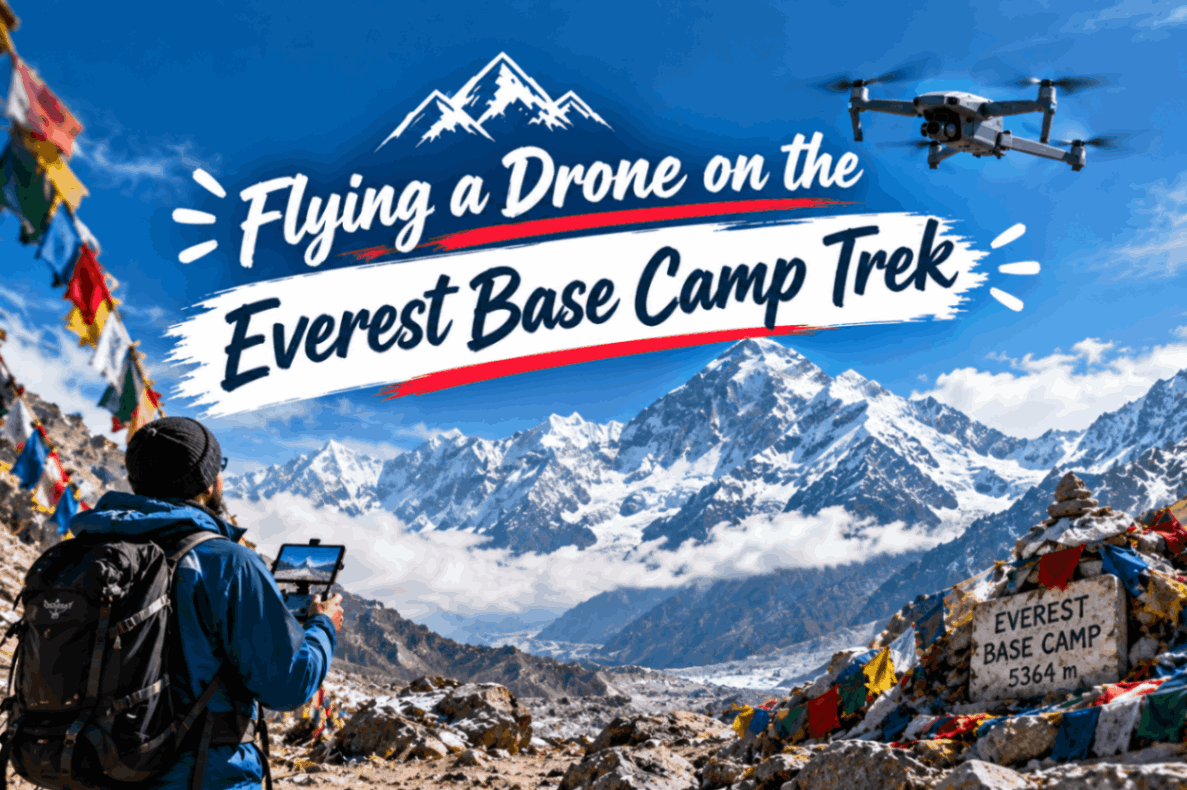
Flying a Drone on the Everest Base Camp Trek
For trekkers heading to Everest Base Camp, drone use sits under extra scrutiny because the entire route runs through Sagarmatha National Park, a UNESCO World Heritage Site.
What This Means in Practice
Flying here requires permission from both the District Administration Office and the Sagarmatha National Park authority, on top of your CAAN registration. Checkpoints along the trail, including near Namche Bazaar, do check for drones, and producing a valid permit showing your exact flight area is the expected response if asked. Without one, confiscation on the spot is standard practice, not an empty threat.
Our Everest Base Camp Trek itinerary passes directly through this park, and our guides can advise on current drone enforcement along the specific stages you’ll be walking, since local rules can shift seasonally in ways that don’t always show up in the central permit system.
Flying a Drone in the Annapurna Region
The Annapurna Conservation Area operates under its own management rules, layered on top of the same CAAN and DAO requirements that apply everywhere else in Nepal.
Routes like the Annapurna Base Camp Trek pass through several distinct checkpoints, and a permit valid for one section of the conservation area doesn’t automatically cover another. If your planned route crosses multiple districts, as most multi-day treks in this region do, you may need more than one local permit to cover the full trip.
Operational Rules Once You Are in the Air
Holding a valid permit does not mean flying however you like. Nepal’s working procedure sets firm operational limits.
| Rule | Limit |
|---|---|
| Maximum altitude (Category A/B, standard permit) | 200 ft above ground level |
| Maximum altitude (pure recreational Category A) | 50 ft above ground level |
| Maximum horizontal range from pilot | 300 metres |
| Minimum ground visibility | 5 km |
| Minimum cloud ceiling | 450 metres |
| Maximum wind speed | 10 knots |
| Operating hours | Daylight only |
Visual line of sight is mandatory throughout every flight. Flying via FPV goggles alone, without a visual observer confirming line of sight, doesn’t satisfy this requirement, and fully autonomous or pre-programmed flight modes are not permitted at all.
Flying a Drone at High Altitude: What Changes
Even with every permit sorted, altitude itself creates practical problems that flat-country flying doesn’t prepare you for.
Battery Performance in the Cold
Lithium battery capacity drops sharply in cold conditions. Below 0°C, expect to lose 30–50% of your drone’s stated battery life, and at 5,000 metres in sub-zero temperatures, effective flight time can fall to as little as 40–60% of the sea-level specification. Keeping batteries warm inside a jacket until just before flight noticeably helps.
Wind and GPS Reliability
Mountain valleys generate their own wind patterns: strong up-valley winds by mid-morning, sudden katabatic gusts off glaciers in the evening, and turbulence near ridgelines that can overwhelm a drone’s stabilisation system. GPS accuracy also weakens in narrow valleys and near steep rock walls, where satellite visibility is limited. Early morning, before thermal winds develop, is consistently the safest and most photogenic window to fly.
Penalties for Flying Without a Permit
Enforcement is real, not theoretical. Any authorised officer who finds a drone flying without a permit can seize it on the spot. Confiscated equipment is logged, reported to police, and passed to CAAN, which can ultimately auction it. Fines under the relevant aviation and electronic transactions legislation can run well into six figures in Nepali rupees, and in restricted zones near borders or military sites, unauthorised flights can be treated as a security matter rather than a simple administrative breach, with the potential for detention or visa complications for foreign nationals.
Should You Bring a Drone Trekking in Nepal?
This depends entirely on your itinerary and priorities.
When It is Worth the Effort
- You have built at least 7 to 10 extra days into your trip specifically for registration and permit approval before your trek starts.
- You’re working with a trekking or production company that can provide the local authorisation letter and handle the DAO application on your behalf.
- Your planned flight locations sit away from national park cores, heritage zones, and airstrips.
- Your drone weighs under 2 kg and is properly registered in advance.
When It Genuinely Is not
- Your itinerary has no buffer for permit delays, which rules out most standard two-week treks.
- You are hoping to fly recreationally inside Sagarmatha or the Annapurna Conservation Area without a dedicated permit.
- Your main goal is casual holiday footage rather than a specific aerial photography project.
A Practical Alternative
Hiring a licensed local drone operator who already holds standing permits for common filming areas is often more cost-effective and far less stressful than pursuing your own permit as a short-term visitor.
A quality action camera or mirrorless camera from a ridgeline viewpoint, meanwhile, produces results that come surprisingly close to a low-altitude drone shot, without touching any of the regulatory process at all.
Conclusion
Flying a drone in Nepal is entirely possible, but it is a genuine bureaucratic process rather than something you sort out after landing. Registration with CAAN, a flight permit from the local District Administration Office, and, for most major trekking regions, separate national park clearance are all non-negotiable steps, and the realistic timeline runs into weeks rather than days.
If you are planning a trek with us and want honest advice on whether a drone is worth bringing for your specific route and dates, get in touch before you fly out. As one of the best trekking companies in Nepal Igloo Himalaya Treks , we would rather tell you plainly whether the permit effort makes sense for your trip than let you find out the hard way at a checkpoint.
Visit our Everest region or Annapurna region pages to see the routes our guides know best, and also you can ask us directly about current drone rules on your planned trail.
FAQs on Flying a Drone in Nepal
Do I need a permit to fly a small drone like a DJI Mini in Nepal?
Yes. Even drones under 250 g fall under Category A and still require CAAN registration and, in most cases, a flight permit before use.
Can I fly a drone at Everest Base Camp?
Only with permits from both the District Administration Office and the Sagarmatha National Park authority. Checkpoints along the trail actively check for drones, and unpermitted units are typically confiscated on the spot.
How much does a drone permit cost in Nepal?
A realistic all-in budget for personal use is roughly USD 100 to 300, covering CAAN registration and a standard flight permit. Filming inside a national park costs significantly more, often around USD 1,500 for foreign nationals.
How long does the drone permit process take?
Allow at least 7 to 15 working days for standard approval, and longer for national park or restricted area applications. Start the process three to four weeks before your trek.
Can I get a drone permit the same day I arrive in Kathmandu?
No. Registration and permit approval are multi-step processes involving several offices and cannot be completed in a day or two, regardless of how the paperwork is prepared.
Do I need a permit to fly a drone in Nepal?
Yes. All drones, including small models under 250 g, must be registered with the Civil Aviation Authority of Nepal (CAAN), and a flight permit is generally required before flying. The exact requirements can vary depending on the drone category, location, and purpose of the flight. For the latest official requirements, check the Civil Aviation Authority of Nepal before planning your drone flight.


