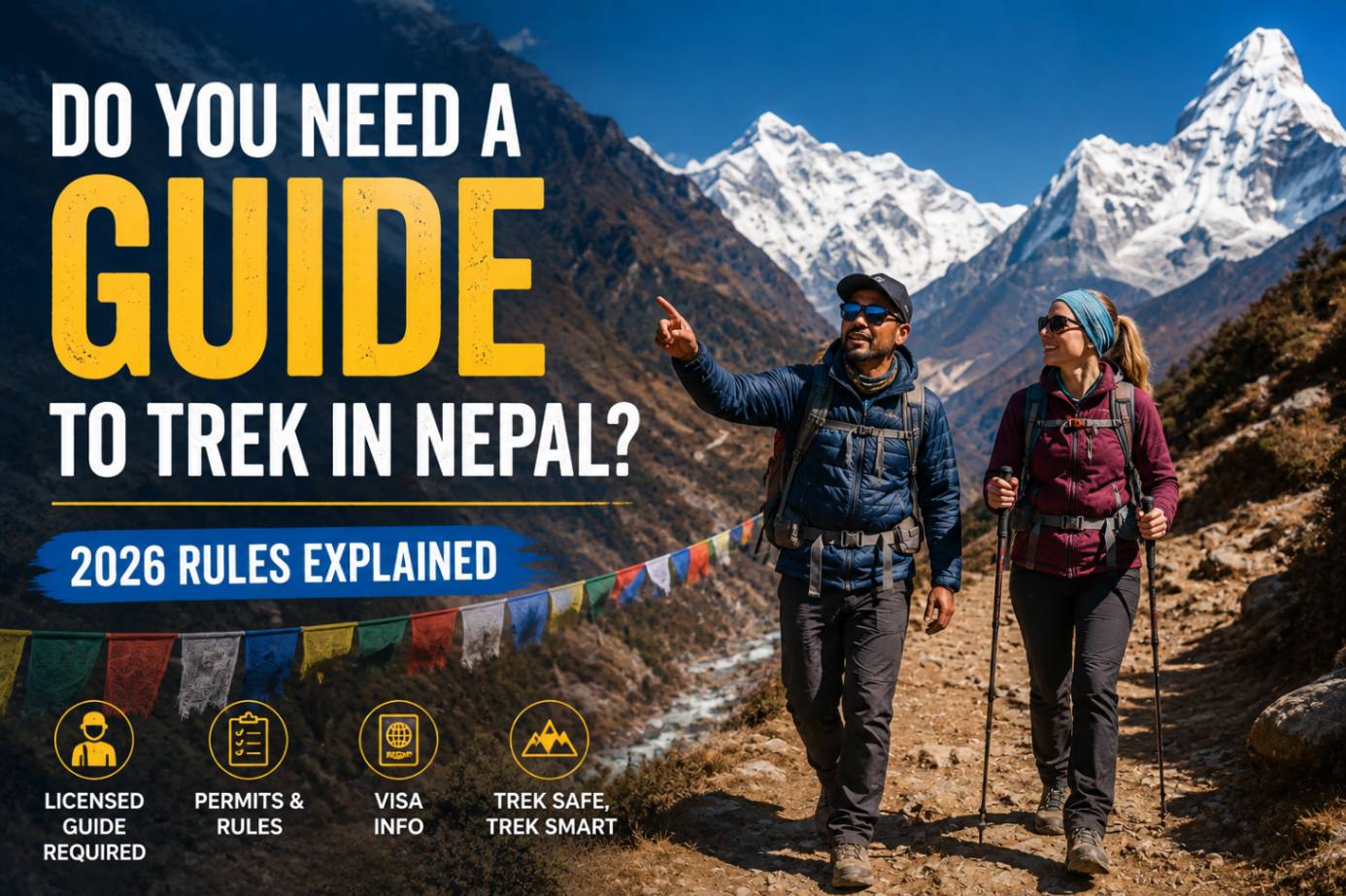
Do You Need a Guide to Trek in Nepal? 2026 Rules Explained
Yes. As of 2026, every foreign trekker entering a national park, conservation area, or restricted area in Nepal must be accompanied by a licensed guide hired through a government-registered trekking agency.
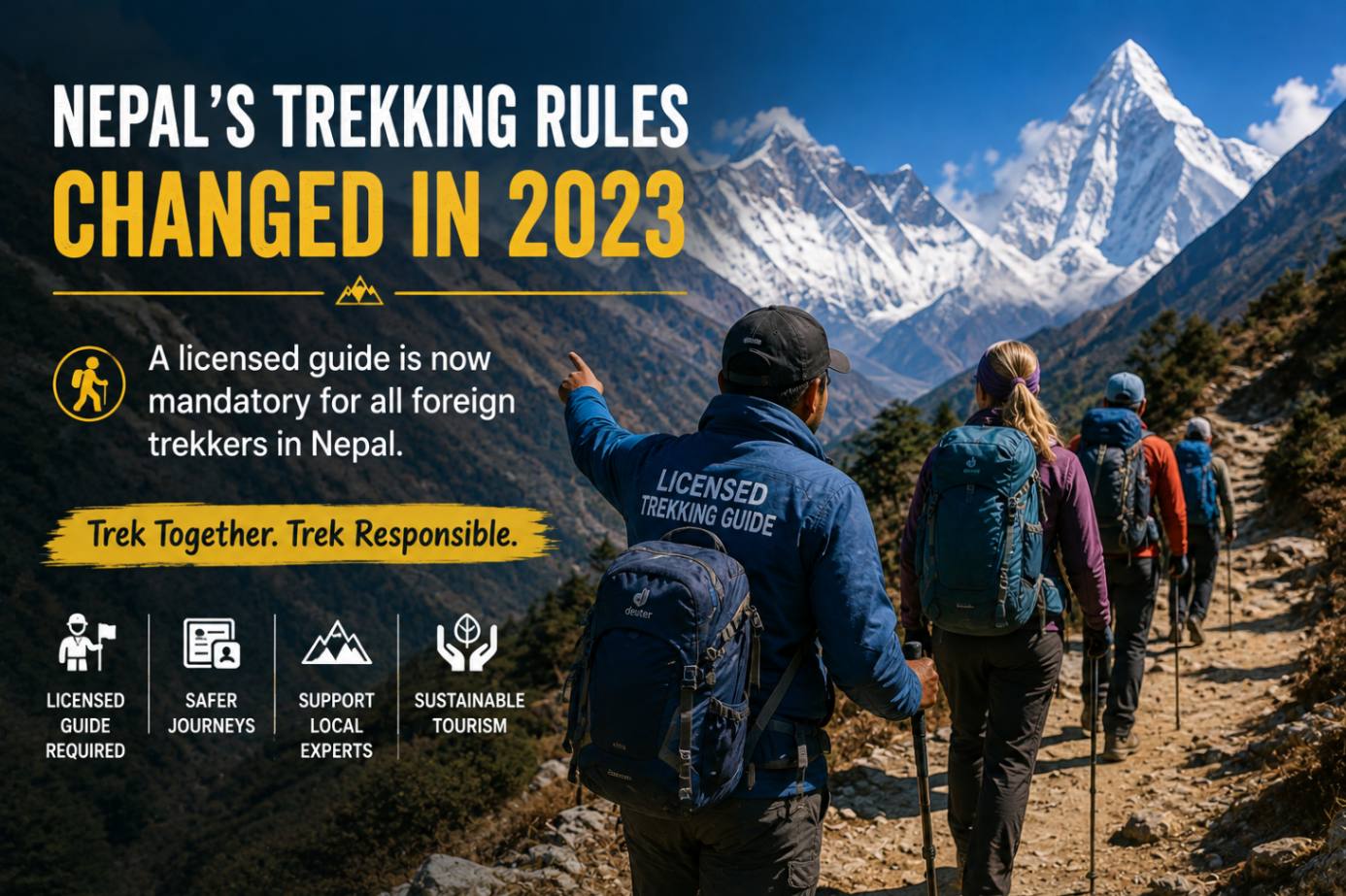
This rule came into effect in April 2023 and is now fully enforced across all major routes, including Everest Base Camp, the Annapurna Circuit, Langtang Valley, and Manaslu. Independent, guideless trekking on these routes is no longer legal, regardless of your experience level.
That is the short answer. The longer answer involves a few moving parts: which permits apply to your specific route, what a guide actually costs, a March 2026 update that changed the rules for restricted areas, and how visa requirements fit into all of it. This guide covers each piece.
What Changed in Nepal’s Trekking Rules
For decades, independent trekkers could buy a TIMS card, pick a route, and walk into the mountains alone.
That changed in April 2023, when the Nepal Tourism Board (NTB) and the Trekking Agencies’ Association of Nepal (TAAN) introduced a mandatory guide requirement following a rise in search-and-rescue incidents involving solo trekkers over the preceding decade.
The rule has been progressively tightened and is now consistently enforced at checkpoints across the country’s popular trekking regions in 2026.
A second, more recent change arrived on 22 March 2026, when Nepal’s Department of Immigration removed the long-standing two-person minimum for Restricted Area Permits, meaning solo travelers can now apply for permits to places like Upper Mustang, Manaslu, and Dolpo without needing to find a second foreign trekker to share the group requirement. The guide requirement itself, however, was not changed by this update; it still applies.
Do You Need a Guide to Trek in Nepal? Where the Rule Applies
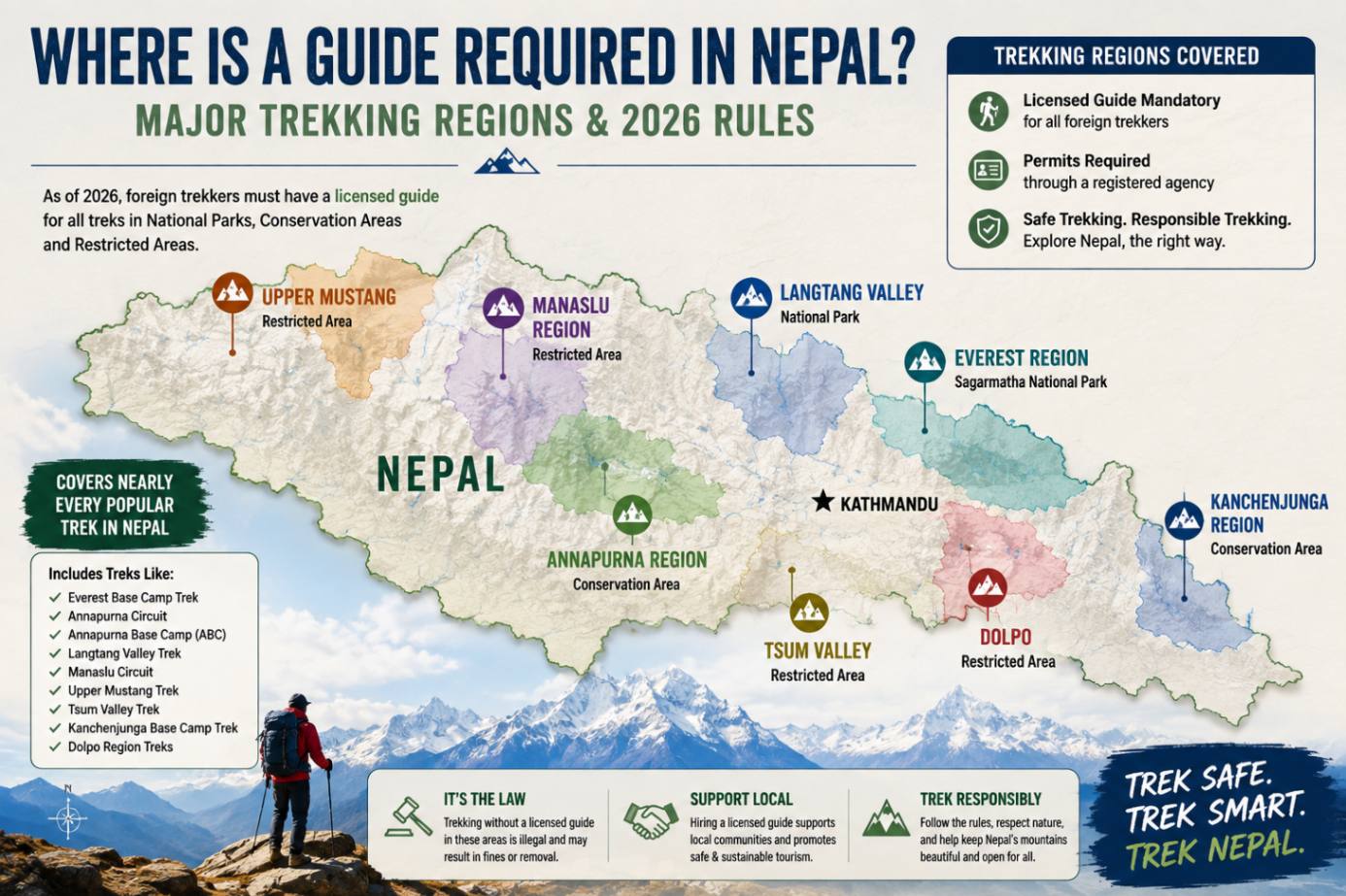
The mandatory guide rule applies to virtually every popular trekking route in the country, since almost all of them pass through a National Park, Conservation Area, or Restricted Area.
This includes the Everest Base Camp Trek and other routes through Sagarmatha National Park, the Annapurna Circuit and Annapurna Base Camp Trek through the Annapurna Conservation Area, the Langtang Valley Trek through Langtang National Park, and every restricted-area route such as Manaslu Circuit, Upper Mustang, Tsum Valley, Nar Phu Valley, Dolpo, and Kanchenjunga. In practice, this covers nearly every trek a foreign visitor is likely to book in Nepal.
The rule applies specifically to foreign nationals. Nepali citizens are not subject to the same guide requirement on most routes, though local permit rules still apply in some conservation and restricted areas.
What Happens If You are Caught Trekking Without a Guide
Trekking without the required permits or guide is illegal, not just discouraged.
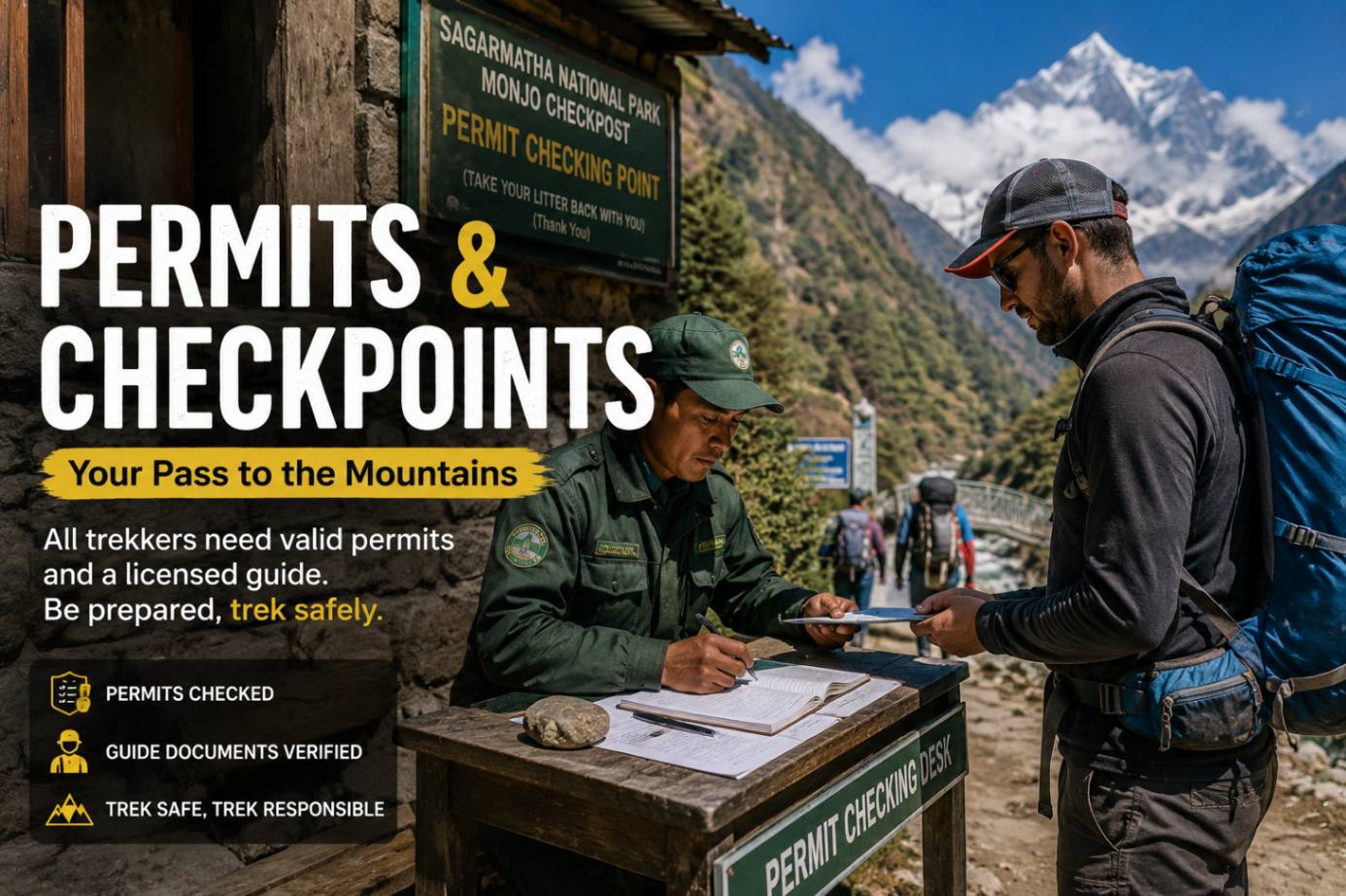
Checkpoints along major routes at places like Monjo (Sagarmatha National Park), Besisahar and Nayapul (Annapurna Conservation Area), and Syabrubesi (Langtang National Park) verify permits and guide documentation before allowing trekkers to continue.
Trekkers found without proper documentation can face immediate removal from the trail, fines, and in some cases, difficulty obtaining permits for future trips.
For restricted areas specifically, permits are only issued through a TAAN-registered agency in the first place, so there’s no route to legally enter these zones without one.
How Much Does a Licensed Guide Cost
Guide rates in Nepal are fairly consistent across the industry, since TAAN sets minimum wage benchmarks that reputable agencies follow or exceed.
-
Guide, Porter, and Porter-Guide Rates
A licensed trekking guide typically costs USD 25 to 35 per day on standard routes, rising to USD 35 to 50 per day for high-altitude or restricted-area routes that require additional certifications, such as Wilderness First Responder training.
A porter, who carries up to 20 to 25 kg (usually shared between two trekkers), costs USD 20 to 25 per day. A porter-guide, a hybrid role combining both jobs, typically runs USD 22 to 30 per day and suits solo trekkers or small groups who want one person handling both navigation and load-carrying.
These daily rates usually cover only the guide’s wage. Trekkers are generally expected to cover the guide’s meals (USD 10 to 20 per day) and accommodation (USD 5 to 15 per night) separately, unless you have booked an all-inclusive package where this is already built into the price.
Tipping at the end of the trek is customary, with USD 100 or more for a two-week trek being a common guideline.
-
Booking Through an Agency vs. Independently
Hiring a guide through a registered agency typically costs somewhat more than arranging one informally in Kathmandu’s Thamel district, but it comes with real advantages: agency guides are licensed, insured, and accountable to a registered business, while informally hired guides are more likely to be unlicensed and uninsured.
If you prefer the added peace of mind of having everything arranged through a registered operator, Igloo Himalaya Treks is one option worth considering, particularly for trekkers who want help with permits, logistics, and guide arrangements.
Given that permits for restricted areas can only be processed through an agency anyway, most trekkers end up booking this way regardless.
How to Verify a Guide Is Actually Licensed
A licensed guide should hold a trekking guide license issued by the Nepal Tourism Board, and reputable agencies will show you this credential without hesitation if asked. Look for agency registration with TAAN and, ideally, with the Nepal Mountaineering Association (NMA) if your route involves any peak climbing component.
If a guide or agency is reluctant to produce documentation, treat that as a warning sign rather than a formality to skip.
Permits You Need Depending on Your Route
Which permits you need depends entirely on which region you’re trekking in. Here’s a breakdown by category.
National Park and Conservation Area Permits (Open Routes)
Most popular routes require a straightforward entry permit, typically NPR 3,000 (about USD 22 to 25) per person:
- Sagarmatha National Park Permit (Everest region) — NPR 3,000
- Khumbu Pasang Lhamu Rural Municipality Permit (Everest region) — NPR 3,000, replacing the TIMS card specifically in this region
- Annapurna Conservation Area Permit (ACAP) (Annapurna region) — NPR 3,000
- Langtang National Park Permit (Langtang region) — NPR 3,000
TIMS Card: Where It Still Applies
The TIMS card (Trekkers’ Information Management System) has been phased out in some regions but still applies on many standard “open” routes outside the Khumbu. In the Everest region specifically, the local municipality permit above has replaced it entirely; a TIMS card is not required there.
On most other general trekking routes, including parts of the Annapurna and Langtang regions, a TIMS card is still commonly required and is arranged through your trekking agency as part of the permit package.
Because rules in this area have shifted more than once in recent years, it’s worth confirming the current requirement for your specific route with the Nepal Tourism Board or your operator before you travel.
Restricted Area Permits (RAP) for Remote Regions
Restricted areas carry higher fees and stricter application rules, since these permits fund infrastructure and conservation in more remote, less-visited parts of the country. As of 2026, approximate rates are:
| Region | Permit Fee |
|---|---|
| Upper Mustang / Upper Dolpo | USD 50 per person per day |
| Manaslu Circuit (Sept–Nov) | USD 100 for the first 7 days, then USD 15/day |
| Manaslu Circuit (Dec–Aug) | USD 75 for the first 7 days, then USD 10/day |
| Tsum Valley (Sept–Nov) | USD 40 for the first week, then USD 7/day |
| Tsum Valley (Dec–Aug) | USD 30 for the first week, then USD 7/day |
| Kanchenjunga | Approximately USD 10 per week |
Manaslu also requires the separate Manaslu Conservation Area Permit (MCAP), around NPR 3,000, plus a small local rural municipality fee. Since Manaslu’s route connects into Annapurna Conservation Area territory near the end, an ACAP is typically required too.
Permit fees for restricted areas are always subject to revision, so treat the figures above as a planning guide rather than a final quote, and confirm current rates with a TAAN-registered agency before booking.
The March 2026 Solo Trekking Update for Restricted Areas
Until March 2026, applying for a Restricted Area Permit required a minimum of two foreign nationals on a single application, which meant solo travelers either had to find a stranger to pair up with or skip these regions entirely. On 22 March 2026, Nepal’s Department of Immigration formally removed this requirement, confirming that individual trekkers can now obtain restricted-area permits without a second foreign national attached to the application.
Two things about this update are worth being clear on. First, applications must still go through a TAAN-registered trekking agency; there is no self-application route for restricted areas. Second, the licensed guide requirement was not affected by this change and remains fully in place.
In short: you can now trek Manaslu, Upper Mustang, or Tsum Valley solo in terms of group size, but “solo” still means “with a licensed guide,” not “unguided.”
Nepal Visa Requirements for Trekkers
Most nationalities can get a Nepal tourist visa on arrival at Tribhuvan International Airport in Kathmandu.
Current fees are USD 30 for 15 days, USD 50 for 30 days, and USD 125 for 90 days. Payment is typically expected in cash, and immigration staff prefer clean, undamaged US dollar notes.
For a standard 12- to 14-day trek, a 15-day visa covers most itineraries, though many trekkers opt for the 30-day visa to build in a buffer for flight delays, Lukla weather backlogs, or extra time in Kathmandu, since the extra USD 20 is a small cost against the risk of an expired visa. Visa requirements are separate from trekking permits; you will need both.
Step-by-Step: Getting Everything Sorted Before You Fly
Here’s a practical order of operations for a first-time trekker:
- Choose your route and confirm which region it falls under: open route (Everest, Annapurna, Langtang) or restricted area (Manaslu, Upper Mustang, Tsum Valley, Dolpo, Kanchenjunga).
- Book with a TAAN-registered trekking agency, since restricted-area permits and the mandatory guide can only legally be arranged this way.
- Confirm your visa plan: apply for a Nepal visa on arrival, or check e-visa options in advance if your nationality requires it.
- Send your documents to your agency ahead of time: passport copy, passport-sized photos, and travel insurance details, since restricted-area permits typically require proof of insurance.
- Let your agency process permits: national park fees, conservation area permits, TIMS (where applicable), and restricted-area permits are usually filed on your behalf once you arrive in Kathmandu or before.
- Meet your guide before departure and confirm their license and your day-by-day itinerary.
Why Most Trekkers Book Through a Registered Agency
Given that a licensed guide is legally required and restricted-area permits can only be processed through a TAAN-registered operator, booking a full package rather than trying to piece together permits and staff independently has become the practical default for the large majority of foreign trekkers in 2026.
A registered agency also carries insurance obligations for its staff, maintains relationships with teahouses and rescue services along the route, and can adjust your itinerary on the fly if a Lukla flight is delayed or weather forces a change of plan all things that are far harder to manage on your own.
Conclusion
Yes, you need a licensed guide to trek in Nepal in 2026, on essentially every popular route in the country, and that guide must be hired through a government-registered agency.
Beyond that, which permits you need and what they cost depends heavily on whether your route runs through an open conservation area or a restricted zone, and the March 2026 update means solo travelers finally have equal access to Nepal’s restricted regions without needing to find a travel partner first.
If you are planning a trek in Nepal, Igloo Himalaya Treks is a TAAN-registered Nepal trekking company that handles guide arrangements, permits, and logistics as part of every package, whether you are heading to Everest Base Camp, the Annapurna Base Camp Trek, the Manaslu Circuit Trek, or a technical objective like Yala Peak Climbing. Their team can also confirm the current permit fees and guide arrangements for your specific route before you book.
You can verify current visa fees on the Department of Immigration, Nepal website and check the latest tourism policy updates through the Nepal Tourism Board.
FAQs
Do you need a guide to trek in Nepal in 2026?
Yes. Since April 2023, all foreign trekkers must hire a licensed guide through a government-registered agency to trek in any national park, conservation area, or restricted area in Nepal, which covers nearly every popular route.
Can I still trek solo in Nepal?
You can travel without a group, but not without a guide. As of March 2026, the old two-person minimum for restricted-area permits was removed, so solo travelers can now get permits for places like Manaslu and Upper Mustang without a second trekker, but a licensed guide is still mandatory.
Is the TIMS card still required?
It depends on the region. In the Everest/Khumbu region, TIMS has been replaced by a local municipality permit. On many other standard routes, a TIMS card is still commonly required and is arranged by your trekking agency. Confirm the current rule for your specific route before you travel, since this has changed more than once in recent years.
How much does a trekking guide cost in Nepal?
Licensed guides typically cost USD 25 to 35 per day on standard routes, and USD 35 to 50 per day on high-altitude or restricted-area routes. Porters cost USD 20 to 25 per day, and combined porter-guides run USD 22 to 30 per day.
What happens if I trek in Nepal without a permit or guide?
It’s illegal. You risk being turned back at a checkpoint, fined, and potentially facing difficulty obtaining permits for future trips. Restricted-area permits can only be issued through a registered agency in the first place, so there’s no legal way around the requirement.
Do I need a separate permit for Everest Base Camp and Annapurna?
Yes, permits are region-specific. Sagarmatha National Park and the Khumbu municipality permit apply to Everest; the Annapurna Conservation Area Permit applies to Annapurna. You’d need both separately if trekking in both regions on the same trip.
How much is a Nepal visa for trekkers?
Visa on arrival costs USD 30 for 15 days, USD 50 for 30 days, or USD 125 for 90 days. Most trekkers on a 12 to 14 day itinerary choose the 30-day visa for a safety buffer.
Can I book a guide independently instead of through an agency?
For open routes, informally hired guides exist, but they’re more likely to be unlicensed or uninsured. For restricted areas, there’s no option to bypass an agency permits are only issued to registered operators.
When should I book a trekking guide in Nepal?
It is best to arrange your licensed guide and trekking package before arriving in Nepal, particularly during the busy spring and autumn trekking seasons. Booking in advance gives you more choice of guides and allows your agency enough time to arrange permits, accommodation, transport, and other logistics before the trek.
Can I choose my own trekking guide in Nepal?
Yes. When booking through a registered trekking agency, you can usually request a guide based on your preferred language, trekking experience, or route. If you have specific needs, such as experience with high-altitude trekking or a particular region, mention them when booking so the agency can match you with a suitable guide.


